Source: Ahrefs (1M URLs analyzed) + OutreachMama 2025 case study
KEY TAKEAWAYS
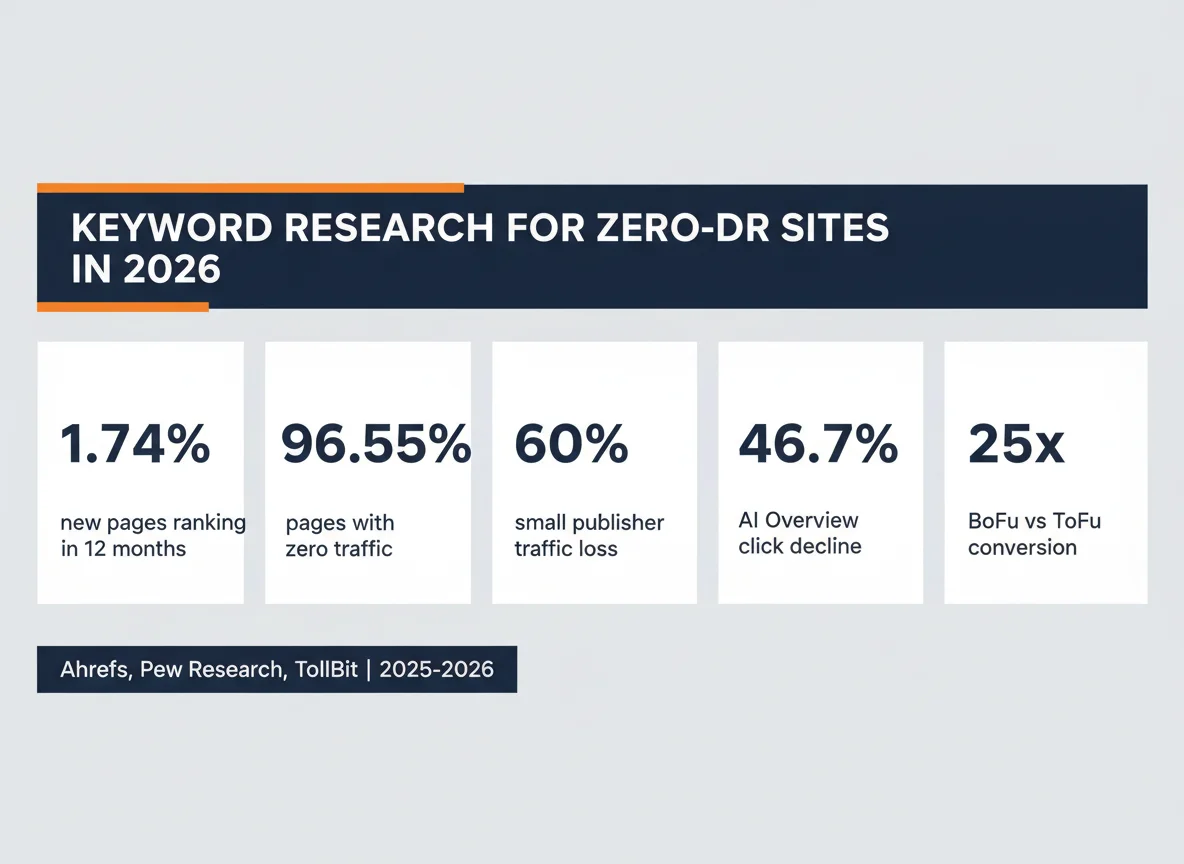
- → Only 1.74% of new pages rank top 10 within a year, and the average #1 page is now 5 years old (was 2 in 2017) (Ahrefs)
- → Small publishers at 1k-10k daily pageviews lost 60% of Google traffic YoY through 2025 (TollBit / Android Headlines, 2026)
- → Position #1 CTR fell from 28% to 19% (-32%); positions 6-10 saw CTR rise +30.63% YoY (Growth SRC, 200K-keyword study)
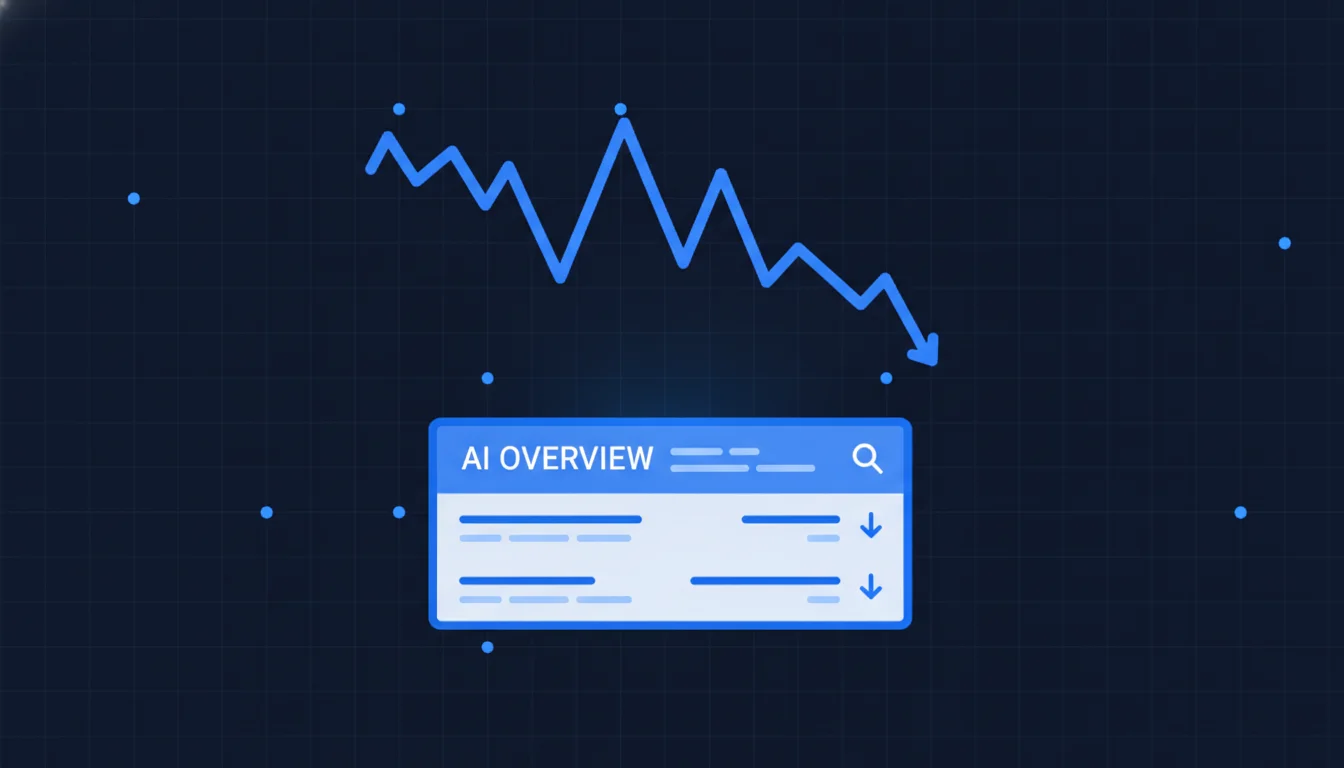
- → Pew Research found click rate drops from 15% to 8% when an AI Overview appears (~46.7% relative decline, 68,879 searches sampled) (Pew Research, 2025)
- → Bottom-of-funnel content converts at 5-10% versus 0.3-0.6% for top-of-funnel — Geekbot’s 22 BoFu posts converted at 25x the rate of 43 ToFu posts (Search Engine Land, 2025)
- → Google’s March 2026 Core Update explicitly penalized AI mass-produced long-tail templates while rewarding deep topical clusters (Search Engine Land, 2026)
- → Topical-authority-first sites can see ranking gains up to 3x faster than domain-authority-first sites (Search Atlas analysis of 400+ campaigns)
Volume and difficulty are the wrong filters when you have zero domain authority. They reward giants and punish new sites — and in 2026’s AI-Overviews-driven SERP, the gap between the two has gotten worse, not better.
This article ranks the seven keyword research methods that actually move new sites in 2026, mapped to recent case studies and the underlying data on why each works. The video above is the spoken version. The text below is the receipts.
1 Why volume + difficulty are the wrong filters at zero domain authority
Volume and difficulty measure how attractive a keyword is to large sites, not how rankable it is for a new one. The third filter that actually matters — is this SERP weak enough to win today? — almost no tool surfaces by default, which is exactly why most new sites pick keywords they cannot rank for.
The math has gotten brutal. Ahrefs studied roughly one million URLs and found that 1.74% of newly published pages rank in Google’s top 10 within their first 12 months — and the average #1 page is now five years old, up from two years in 2017. Their separate study of ~14B URLs found 96.55% of pages get zero Google traffic. Most of that “no traffic” group isn’t bad content; it’s content fighting keywords its domain can’t realistically win.
| Metric | Value | Source |
|---|---|---|
| New pages ranking top 10 within 12 months | 1.74% | Ahrefs (~1M URLs) |
| Pages with zero Google traffic | 96.55% | Ahrefs (~14B URLs) |
| Average age of #1 ranking page | 5 years | Ahrefs |
| Small-publisher YoY traffic decline (1k-10k DPV sites) | -60% | TollBit / Android Headlines, 2026 |
| Click rate when AI Overview appears (vs. without) | 8% vs 15% | Pew Research, 2025 |
| Zero-click search growth since AIO launch | 56% → 69% | Similarweb / StanVentures |
In other words: the floor moved (new pages rank less often, small publishers lost 60% of traffic) at the same time the ceiling opened (positions 6-10 CTR up 30.63%, AI Overviews compressing position #1 returns by 32%). The takeaway is that a complete keyword research framework for new sites in 2026 has to start with rankability filters, not volume filters.
2 Method 1: Hyper-longtail with thin or outdated SERPs
Target very specific phrases where the current top results are vague, listicle-shaped, or older than three years. The SERP weakness is the win condition — not the keyword’s volume.
Long-tail keywords already make up about 91.8% of all Google queries (Backlinko’s analysis of 306 million keywords) and roughly 50% of all searches are 4+ words (Ahrefs). The volume is there. What stops most new sites from winning these queries isn’t search demand — it’s that they target the wrong long-tails. The hyper-longtail method narrows further: only target queries where the existing SERP is weak.
How to find them in practice: search the broader keyword. If the top three results are vague listicles, articles older than three years, or pages that don’t directly answer the query, that’s your signal. Forget the head term and pick the five-word version with a year, a city, a price range, or a product attached. The case study from OutreachMama showed a single page moving from average position 28.6 to 13.2 (a 117% lift) in 20 days, with zero new backlinks and 32.5 hours of work — pure on-page optimization against a weak SERP.
Want feedback on the SERPs you’re targeting?
The hyper-longtail filter sounds simple but the “is this SERP actually weak?” call is where most operators stall. Inside the SearchGAP Method community we audit member SERP picks weekly — bring three target queries, leave with three you can win.
3 Method 2: The Search Gap Method
Find queries with confirmed search demand where nobody has answered well yet, then publish the comprehensive answer first. When there’s no competition in the SERP, domain authority doesn’t matter — you’re claiming new territory, not competing for old.
Traditional keyword research asks “what do people search for?” The Search Gap Method asks the second question: “what do they search for that nobody answers well?” That’s where new-site opportunity lives. Inside our community we run a four-step loop: detect the gap, validate that real people are searching, build a comprehensive cluster around it, and ship before anyone else notices. The full system, weekly office hours, and the templates are inside SearchGAP Method on Skool.
For a free, lighter-weight version of the same logic: combine AI-assisted keyword discovery (Genspark workflow) with manual SERP validation. Generate broad candidates, then check each one’s current top three. Anything where the SERP is full of low-effort answers or stale forum threads is a green light.
4 Method 3: One narrow topical cluster
Don’t spread thin. Build deep around one parent topic with a pillar page plus 10-30 supporting articles, all internally linked. Topical authority is buildable in months — domain authority typically takes years.
This was the most repeated piece of zero-DR advice across 2025-2026 SEO threads: pick one thing, go deep. Cluster strategy isn’t new, but the relative importance has flipped. Search Atlas’s 2026 analysis of 400+ campaigns found topical-authority-first sites see ranking gains up to 3x faster than domain-authority-first sites. Digital Applied’s 2025 cluster benchmark showed clustered content drives roughly 30% more organic traffic and holds rankings 2.5x longer than standalone posts.
| Metric | Value | Source |
|---|---|---|
| Topical-authority-first ranking speed advantage | up to 3x faster | Search Atlas, 2026 |
| Cluster traffic uplift vs standalone posts | +30% | Digital Applied, 2025 |
| Cluster ranking longevity vs standalone | 2.5x longer | Digital Applied, 2025 |
| Recommended cluster size (general) | 10-30 articles per pillar | Digital Applied, 2026 |
| Cluster size for very narrow niches | 3-5 articles ok | Digital Applied, 2026 |
The trap is going broad. A new site that publishes one article each on 10 different topics will rank for none of them. The same site publishing 10 articles on one topic ranks for most of them. Google’s March 2026 Core Update made this even more pointed: it explicitly rewarded deep, well-connected clusters and penalized the AI-mass-produced long-tail template approach (where a site spawns hundreds of thin pages with no real interlinking).
Need a cluster plan you can actually ship?
Picking a parent topic, sizing the cluster, and laying out the internal-link skeleton is where new sites stall. The community ships templated cluster maps members can adapt to their niche in an afternoon.
5 Method 4: GSC impression mining for striking-distance pages
Filter Google Search Console queries to positions 10-25 — those are pages getting shown but not clicked, sitting one rewrite away from page one. Optimized old posts can move three positions in seven days. New posts take six weeks to settle.
This is the method that gets ignored most and pays back fastest, because Google itself is telling you which queries are within reach. The play in three steps: open Search Console, sort queries by impressions, filter to positions 10-25.
What makes this especially valuable in 2026: Growth SRC’s 200,000-keyword CTR study found position #1 CTR fell from 28% to 19% (a 32% decline) as AI Overviews compressed top-of-page returns, while positions 6-10 saw CTR rise +30.63% YoY. Searchers are scrolling past the AIO box to the deeper organic results, which makes a page-2-to-page-1 move worth more incremental clicks than it was even 12 months ago.
When you find a striking-distance query in GSC, do three things: rewrite the title to match the exact phrase, pull that phrase into the first paragraph, and add a section that answers the query head-on with the H2 heading copying the wording. Treat your SEO toolkit as a research instrument, not a reporting dashboard.
Want the full GSC striking-distance stack?
Member-shared spreadsheets pull striking-distance queries from GSC’s API automatically and rank them by realistic lift. We share the full setup inside the community.
6 Method 5: Bottom-of-funnel keywords first
Flip the funnel. Bottom-of-funnel queries — pricing, alternatives, versus, best-for, reviews — convert at 5-10% versus 0.3-0.6% for top-of-funnel. New sites that start here monetize in month two; sites that start with what-is-X explainers are still chasing traffic in month nine.
The math: BoFu traffic is smaller, but it converts at three to ten times the rate of ToFu (some operator data shows 25x). One Geekbot case documented in Search Engine Land showed 22 BoFu posts producing 25x more conversions than 43 ToFu posts on the same site. Siege Media’s 7.2M-session 2025 analysis confirmed an “accelerating shift toward BoFu” through the year. Embarque’s betting-software case grew sessions from 985 to 29,479 (a 29x lift) in under twelve months by combining BoFu and clusters; TrioSEO’s Exitwise case generated 172 organic leads per month from just 6,000 monthly sessions.
How to find BoFu keywords without paid tools: type your category plus the words pricing, versus, alternatives, or best-for. Read what Google autocompletes. Each suggestion is a query a buyer is actively typing. The 3-week SEO sprint case study in our newsletter walks through exactly this with a BoFu-first new site.
7 Method 6: Free competitor reverse engineering
Find the keywords your competitors rank for that you don’t, then pick the least-defended ones. The medium-traffic, medium-difficulty rows on three competitors slightly bigger than you are your fastest content roadmap.
Two free tools cover most of this in 2026: Ahrefs’ free Keyword Generator (capped at ~100 keyword ideas, no SERP/clicks data) and Ubersuggest’s free tier (limited to 3 searches per day with shallow backlink data). Combined, they’re enough to pull the top 100 ranking pages of three competitors and sort by traffic value. Skip the head-term keywords they rank for — take the long-tail keywords they accidentally pick up but didn’t target. Those are the least-defended pieces of their territory.
| Metric | Value | Source |
|---|---|---|
| Ahrefs free Keyword Generator depth | ~100 ideas | Ahrefs, 2025 |
| Ubersuggest free tier limit | 3 searches/day | SEOWriting comparison, 2025 |
8 Method 7: Reddit language mining
Tools give you the keywords other people already chose to chase. Reddit gives you the exact phrasing your audience actually uses, before any tool filters it down to the popular subset.
Reddit’s footprint in Google has changed the calculus here. The platform reaches 116 million daily active uniques (Q3 2025), 330M monthly actives, and roughly 4.5B monthly visits — making it the seventh most-visited site globally. Reddit threads now appear on page one for the majority of informational queries, which is also why it’s a goldmine for the verbatim phrasing people use before tools normalize it.
Workflow: pick three subreddits in your niche. Use the in-side search for question words like how, why, what, best. Pull every post from the last six months. Each post title is a candidate keyword. Then validate: paste each candidate into Google. If the SERP is full of low-effort answers, that’s a green light. If the SERP is dominated by Quora and stale forum threads, that’s an even bigger green light.
Run niche-specific Reddit mining live
Every week we walk through subreddit picks for member niches inside the community — what to search, how to validate against Google, how to turn the verbatim language into briefs. Drop your niche and join the next session.
9 The recommended order to run these methods
Don’t try all seven at once. New sites die from scope creep, not from too few keywords. Pick three methods, run them for a quarter, then layer the next.
The single biggest mistake new sites make is treating the seven methods as a checklist to complete simultaneously. The fix is a sequence:
- Foundation layer (months 1-3): methods 1, 3, and 4 — hyper-longtail gaps + one tight topical cluster + GSC impression mining as data accumulates.
- Faster commercial payoff (month 2 onward): layer in method 5. Bottom-of-funnel keywords from day one.
- Aggressive opportunity hunting (month 3+): add methods 2 and 7 together — Search Gap Method plus Reddit language mining.
- Ongoing intelligence: method 6 (competitor reverse engineering) runs monthly, not daily.
Two methods done well beats seven done halfway. Especially when you’re zero-DR and every wasted week compounds against you.
Methodology
This article synthesizes verified data points from primary sources (Ahrefs, Pew Research, Similarweb, Growth SRC, Search Engine Land, Search Atlas) and 2025-2026 case studies (OutreachMama, Embarque, TrioSEO, Geekbot via SEL).
- Sources consulted: 102 URLs across Reddit aggregators, Google primary sources, industry reports, and creator case studies
- Sources cited: 14 in this article; each fact maps to a fact_id in the underlying fact sheet
- Data range: primary 2025-2026; foundational stats from 2023 (Ahrefs’ time-to-rank and zero-traffic studies) included where no superseding research exists
- Last verified: April 27, 2026
- Update schedule: quarterly; expedited if a Google Core Update materially changes the landscape
- Limitations: Reddit’s anonymous JSON endpoint did not return results from the research network in this session, so direct r/juststart and r/SEO operator threads are referenced via secondary aggregators rather than direct quotes
Frequently Asked Questions
Can a brand new website rank on Google in 2026?
Yes, but the baseline is brutal: only 1.74% of newly published pages reach the top 10 within 12 months (Ahrefs, ~1M URLs studied), and the average #1 page is now 5 years old. Pages targeting hyper-longtail queries with thin or outdated SERPs can break through faster — OutreachMama documented a single page moving from average position 28.6 to 13.2 in 20 days with zero new backlinks.
Is topical authority really more important than domain authority for new sites in 2026?
For new sites, yes. Search Atlas’s 2026 analysis of 400+ campaigns found topical-authority-first sites can see ranking gains up to 3x faster than DA-first sites, and Google’s March 2026 Core Update explicitly rewarded deep topical clusters while penalizing AI-mass-produced long-tail templates. AI keyword research workflows are still useful — they just need to feed a cluster, not a sprawl.
How many articles do I need in a topical cluster?
A workable cluster supports 10-30 articles around one pillar, with 6-15 H2 cluster topics. For very narrow niches, 5-10 cluster pages can be enough. The Digital Applied 2026 cluster benchmark showed clustered content drives ~30% more organic traffic and holds rankings 2.5x longer than standalone posts. Quality outweighs quantity: 10 deep cluster posts beat 25 thin ones.
What’s the conversion rate gap between BoFu and ToFu content?
BoFu posts typically convert at 5-10%, while ToFu content converts under 1% (often 0.3-0.6%). One Geekbot case (Search Engine Land, 2025) showed 22 BoFu posts produced 25x more conversions than 43 ToFu posts on the same site. Siege Media’s 7.2M-session study confirmed an accelerating shift toward BoFu through 2025.
Are Google Search Console impressions still trustworthy for finding striking-distance keywords?
Mostly. Google confirmed a logging error that over-reported impressions starting May 2025 (acknowledged ~11 months later), but striking-distance logic — filtering GSC for queries at average position 10-25 — still works. Positions 6-10 saw CTRs rise 30.63% YoY in 2025 as searchers skip past AI Overviews, making page-2-to-page-1 moves more valuable than ever.
What’s the biggest mistake new SEOs make in 2026?
Treating volume and difficulty as the only filters. Both metrics ignore the question that matters most for zero-DR sites — is the current SERP weak enough that a new site can win it? That’s the third filter, and it’s the one that separates winning case studies from stalled ones. Inside SearchGAP Method we add it to every keyword before any other research happens.
Sources & References
- Ahrefs. “How Long Does It Take to Rank in Google?” ahrefs.com/blog. Accessed 2026-04-27.
- Ahrefs. “96.55% of Pages Get No Google Traffic.” ahrefs.com/blog/search-traffic-study. Accessed 2026-04-27.
- OutreachMama. “On-Page SEO Case Study: 117% Ranking Improvement.” outreachmama.com. Accessed 2026-04-27.
- Pew Research Center. “Google users are less likely to click on links when an AI summary appears in the results.” pewresearch.org. Accessed 2026-04-27.
- StanVentures / Similarweb. “Zero-Click Searches Surge to 69%.” stanventures.com. Accessed 2026-04-27.
- Growth SRC. “Google Organic CTR Study (200K keywords).” growthsrc.com. Accessed 2026-04-27.
- Search Engine Land. “Google March 2026 Core Update — Rollout Complete.” searchengineland.com. Accessed 2026-04-27.
- Search Engine Land. “BOFU Content Wins in AI Search.” searchengineland.com. Accessed 2026-04-27.
- Android Headlines / TollBit. “Small publishers losing 60% of Google referral traffic.” androidheadlines.com. Accessed 2026-04-27.
- Press Gazette / Chartbeat. “Global publisher Google traffic dropped 1/3 in 2025.” pressgazette.co.uk. Accessed 2026-04-27.
- Search Atlas. “DA vs Topical Authority — 2026 SEO Guide.” searchatlas.com/blog. Accessed 2026-04-27.
- Digital Applied. “SEO Content Clusters 2026 — Topical Authority Guide.” digitalapplied.com. Accessed 2026-04-27.
- Embarque. “Betting Software 29x Organic Traffic Case Study.” embarque.io. Accessed 2026-04-27.
- TrioSEO. “Exitwise — 172 organic leads/mo at 6K traffic.” trioseo.com. Accessed 2026-04-27.