Every website holds a story behind the scenes and every team wants to understand what visitors do, what content matters and how to grow smarter. Tools for gathering this kind of insight come in many shapes. Some focus on privacy, others on deep analytics and there are those that offer clever automation or a simple experience anyone can use. Whether you are curious about real time traffic, want practical guidance for content or need to handle huge piles of data without getting tangled up, the world of analytics offers surprising solutions. The best part is how these tools go beyond just counting visits and make sense of complex questions. See how each one brings a different way to turn messy numbers into plans and answers.
Table of Contents
Words at Scale

At a Glance
Words at Scale presents itself as a focused solution for organizations that need to process language data at scale, combining automation and integration potential to accelerate language-based workflows. The public page available here is sparse, but the platform’s stated emphasis—language processing automation and scalability—matches typical needs for teams handling high volumes of text. For marketers and developers who prioritize throughput and efficiency, Words at Scale is positioned as a practical, purpose-built option.
Core Features
According to the product data, Words at Scale centers on language processing automation, scalability for large-scale tasks, and potential integration capabilities. That combination means the platform is meant to remove repetitive language workflows, handle growing data volumes without constant reconfiguration, and plug into existing pipelines via integrations. While the live page available during this review shows limited content, the declared feature set signals an engineering-first product aimed at operational efficiency and programmatic access.
Pros
- Designed for large-scale language tasks: The platform is explicitly intended to handle high-volume language processing, which reduces the need for manual intervention when datasets grow into the millions of records.
- Automation-focused to save time and resources: Automation capabilities are positioned to cut repetitive work—freeing teams to focus on analysis and strategy rather than preprocessing and routing text data.
- Built with scalability and efficiency in mind: The emphasis on scalability suggests infrastructure and workflows that adapt as projects increase in size, helping avoid brittle solutions that fail under load.
- Complementary educational and tooling resources: wordsatscale.com also appears to function as an educational portal, promoting a free 7-day advanced keyword research academy and free SEO/blogging tools—resources that extend value beyond raw processing capabilities.
Who It’s For
Words at Scale is best suited for businesses, product teams, and developers who need reliable automation for language-heavy workloads—think customer feedback analysis, large-scale tagging, or ingestion for language models. If your team is scaling from hundreds to hundreds of thousands of text items and you need consistent throughput with integration points into your stack, this product is built with your profile in mind.
Unique Value Proposition
What sets Words at Scale apart is the combined focus on both technical scalability and practical enablement: it positions itself as an engineering-ready language automation platform while the public site also emphasizes education and free tools to help users improve organic traffic and content strategy. That dual approach—robust processing capabilities plus resources like a 7-day advanced keyword research academy and free SEO tools—creates a compelling bridge between data operations and content performance. For organizations that must both process massive language datasets and convert insights into actionable SEO or content improvements, Words at Scale delivers a uniquely integrated proposition compared to single-focus tools.
Real World Use Case
A customer experience team uses Words at Scale to ingest and automatically categorize hundreds of thousands of product reviews each month, extracting sentiment, themes, and priority bugs. The automation routes critical issues to engineering, groups feature requests for product, and feeds insights into content planning—accelerating decision cycles from weeks to days.
Pricing
Not specified on the current page. Free tools and an academy are promoted, but product pricing and tiers require direct inquiry or site exploration.
Website: https://wordsatscale.com
Google Analytics
At a Glance
Google Analytics is a robust web analytics service that gives you detailed visibility into who visits your site, how they behave, and which channels drive conversions. It’s especially useful for measuring advertising ROI and tying campaign performance to on-site outcomes. The platform is free for most features, integrates tightly with other Google products, and offers highly customizable reporting—yet beginners can find the interface and concepts steep at first. Bottom line: a powerful, cost-effective analytics backbone for blogs and sites that are ready to invest some time learning it.
Core Features
Google Analytics provides real-time data tracking, audience demographics and interest reports, behavioral flow visualizations, conversion tracking with goals, and the ability to build custom reports and dashboards. Because it’s part of Google’s marketing ecosystem, it also connects with Google Ads to help you measure ad-driven traffic and conversions. Those capabilities let you move from high-level traffic trends into granular audience segments and conversion paths without switching platforms.
Stop. Think. Learn.
Pros
- Comprehensive data insights: Google Analytics consolidates traffic, engagement, and conversion metrics so you can see the full visitor journey in one place.
- Free to use for basic features: Most blogs and small sites can access meaningful analytics without a subscription, lowering the barrier to data-driven decisions.
- Integration with other Google services: Native links to Google Ads and other Google tools streamline campaign measurement and reporting.
- User-friendly interface for analysis and reporting: The UI organizes reports logically, helping you find key metrics and build dashboards without heavy setup.
- Highly customizable reporting options: You can create custom reports and dashboards tailored to the specific KPIs that matter to your blog or business.
Cons
- Data sampling with large datasets: When you analyze very large datasets, Google Analytics may sample the data, which can distort accuracy for high-volume sites.
- Steep learning curve for beginners: New users often struggle with configuration, goal setup, and interpreting advanced reports, which delays actionable insights.
- Privacy concerns with tracking user data: Using Google Analytics raises privacy and compliance questions that require careful handling and possible consent mechanisms.
Who It’s For
Google Analytics is ideal for digital marketers, website owners, SEO specialists, data analysts, and enterprise marketing teams who need deep, customizable insights into audience behavior and campaign performance. If you run a blog or e-commerce site and are willing to learn the platform or have access to analytics support, this tool will scale with your needs.
Unique Value Proposition
The unique value of Google Analytics lies in its combination of rich, customizable analytics and seamless integration with Google’s advertising and marketing stack. That blend makes it possible to link ad spend to on-site conversions and to pivot strategy based on behavioral signals without leaving the platform.
Real World Use Case
A small e-commerce blog owner uses Google Analytics to track visitor behavior, measure the effectiveness of marketing campaigns, and optimize content and product pages to increase sales. By setting up goals and custom dashboards, they can see which posts drive conversions and which traffic sources are most profitable.
Pricing
Free tier available; premium options available for enterprise needs.
Website: https://analytics.google.com
Matomo
At a Glance
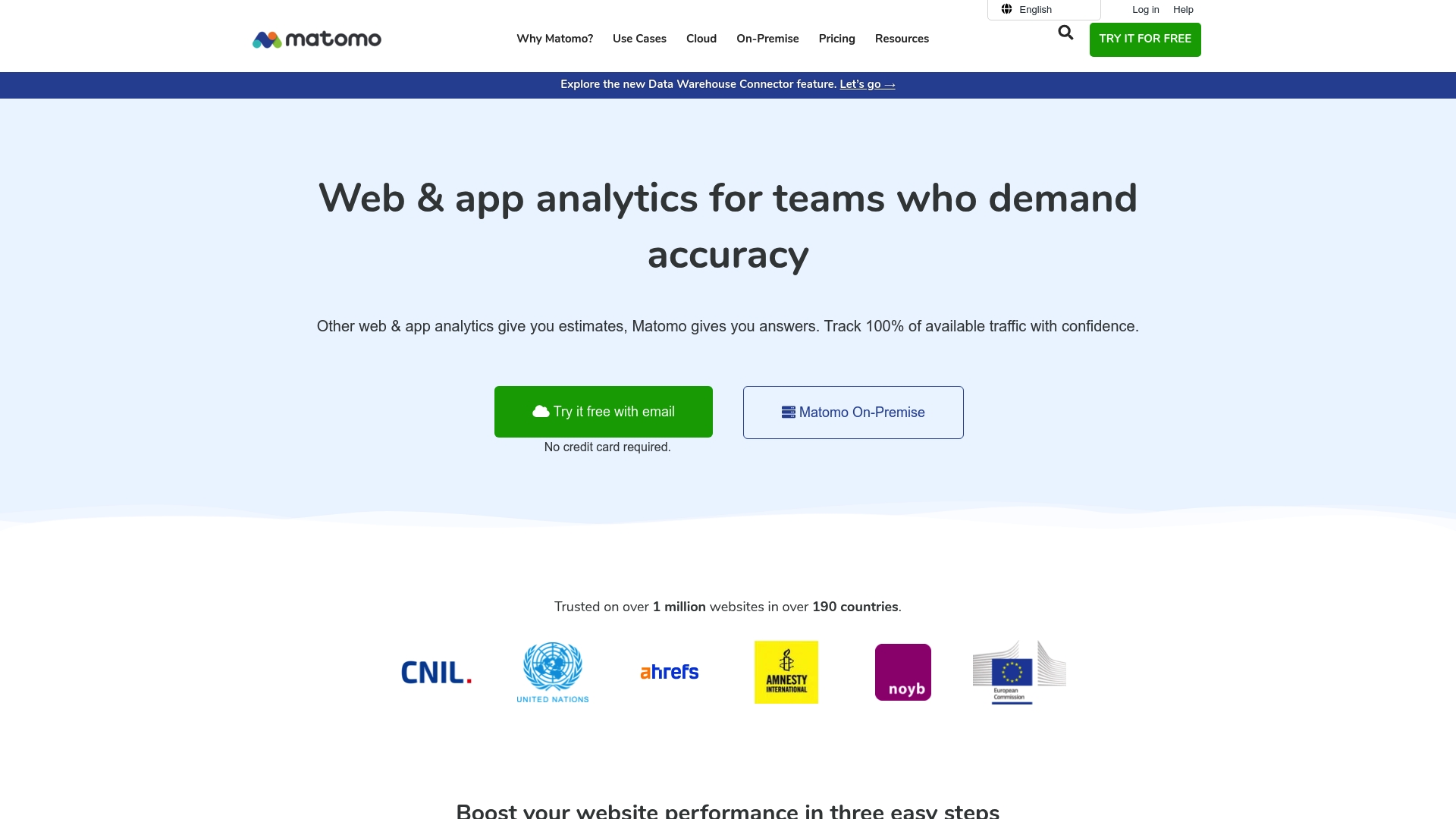
Matomo is a privacy-first web analytics platform that positions itself as an alternative to Google Analytics by offering full data ownership, real-time reporting, and explicit privacy compliance such as GDPR and CCPA. You can self-host it or use Matomo Cloud, which gives teams control over where data lives and how it’s processed. If privacy and transparency rank highest on your checklist, Matomo delivers — but expect a steeper technical lift if you self-host.
Core Features
Matomo’s core capabilities center on privacy and control: 100% data ownership, an open source codebase, and no artificial limits on websites, users, or segments. The platform provides real-time analytics, customizable reports, secure personal data tracking, and a Google Analytics data importer for migrations. There’s no data sampling, so reports reflect complete datasets, and the platform is extendable with plugins and expert support to tailor analytics to complex requirements.
Pros
- Full control over data with flexible hosting options: You can host Matomo on-premise or use the cloud option to ensure your data lives where you want it.
- Strong privacy protections and regulatory compliance: Matomo is built with GDPR and CCPA compliance in mind, making it a reliable choice for privacy-focused organizations.
- Unlimited data storage and tracking: The platform imposes no limits on websites, users, or segments, which is ideal for sites with substantial or growing traffic.
- Open source transparency: Because Matomo is open source, you can audit and extend the codebase to match security and functionality requirements.
- Google Analytics importer simplifies migrations: The ability to import historical GA data eases transitions away from other analytics providers.
Cons
- Requires technical knowledge for on-premise setup: Self-hosting Matomo demands system administration skills and time to configure securely.
- Potentially higher setup complexity than managed services: Compared with fully managed analytics solutions, Matomo’s flexibility comes with more configuration steps and maintenance overhead.
- Cost varies with data volume and hosting choice: While the platform itself can be cost-effective, expenses for cloud plans or infrastructure scale with hits and storage needs.
Who It’s For
Matomo suits organizations and website owners that prioritize privacy and need full control over analytics data—legal teams, public institutions, and privacy-conscious businesses. It’s especially appropriate if your team can handle technical setup or has access to Matomo experts for hosted support.
Unique Value Proposition
Matomo’s unique value is the combination of privacy-first design, open source transparency, and ownership of raw data without sampling limits. That mix lets you run compliant analytics while retaining the freedom to customize, extend, and migrate historical data as needed.
Real World Use Case
A university can replace Google Analytics with Matomo to ensure student and faculty data privacy while keeping detailed web traffic insights. Matomo enables compliant tracking of user behavior, preserves historical analytics via import tools, and supports faculty reporting needs without exposing raw data to third parties.
Pricing
Starting at €29 per month for up to 100,000 hits; custom pricing is available for higher volumes and enterprise solutions, and a free trial is available.
Website: https://matomo.org
Simple Analytics
At a Glance
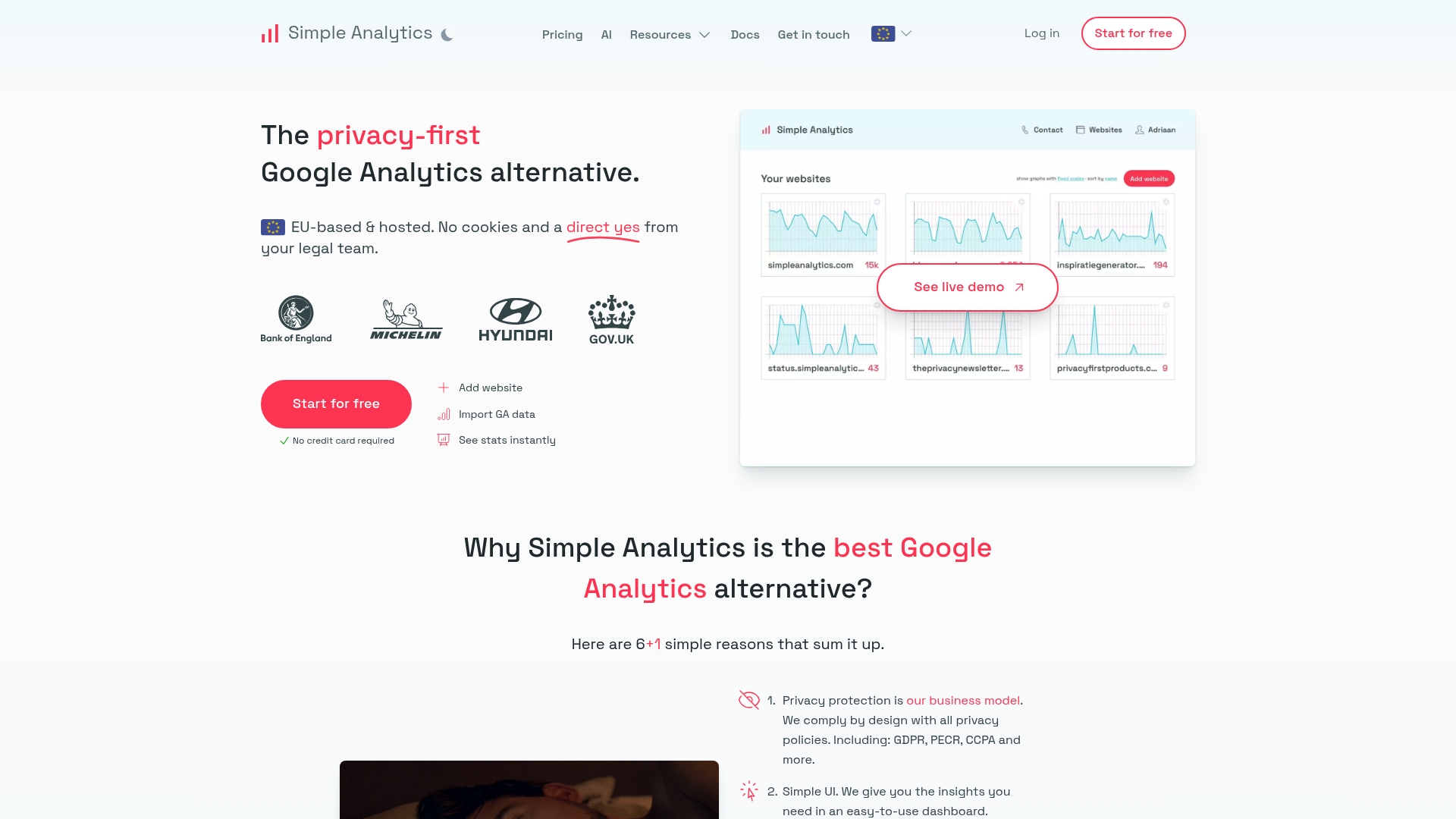
Simple Analytics is a privacy-first, EU-based analytics tool that gives you essential website insights without cookies or personal data collection. It’s GDPR, PECR, and CCPA compliant and offers a straightforward dashboard plus AI-powered chat for quick analysis. There’s a free forever tier for small sites, and paid plans scale up to enterprise-level usage. If you prioritize visitor privacy and simple, actionable metrics, Simple Analytics delivers—though power users may miss some advanced capabilities.
Core Features
Simple Analytics centers on privacy and ease of use: no cookies, no personal data storage, and compliance with major privacy laws. The dashboard surfaces key insights clearly, backed by an AI-powered chat that helps you ask questions about your data. Conversion tracking comes via a goals-tracker and events explorer, while a lightweight script minimizes page speed impact. For teams that need deeper analysis, Simple Analytics supports data export to Power BI, Google Looker Studio, and data lakes, plus automated email reports and widget integration for mobile dashboards.
Privacy matters. And yes, it shows.
Pros
- Privacy-first by design: The tool collects no personal data and operates cookie-free, protecting visitor privacy while simplifying compliance.
- Clear, user-friendly dashboard: The interface focuses on essential metrics, making it easy to spot trends without getting lost in complexity.
- AI chat for quick insights: Built-in AI assistance helps you interpret numbers and ask targeted questions without building custom queries.
- Free forever option: A lifetime free tier lowers the barrier to entry for hobby sites and small projects.
- Export and integration options: You can push data to Power BI, Looker Studio, or data lakes, and use widgets or email reports for broader workflows.
Cons
- Limited historical data on free plan: The free tier restricts data history to 30 days, which can hinder trend analysis and seasonality checks.
- Higher cost at scale: Paid tiers escalate to $15/month for basic paid plans, $40/month for team features, and custom enterprise pricing from $750/month, which may be expensive for large organizations.
- Less feature depth than full analytics suites: Compared with comprehensive platforms, it lacks some advanced segmentation, funnel analysis, and attribution modeling features.
Who It’s For
Simple Analytics suits privacy-conscious website owners, small to medium businesses, and organizations that need GDPR-compliant analytics without the complexity of enterprise tools. If you manage a blog, small store, or marketing site and want straightforward visitor trends without legal headaches, this tool fits well.
Unique Value Proposition
Simple Analytics’ core proposition is ethical data collection: meaningful, cookieless analytics that respect user privacy while remaining easy to use. The AI-driven chat and clean dashboard let non-technical users extract insights quickly, and export options bridge the gap to more powerful BI tools when needed.
Real World Use Case
A small online store migrates from a cookie-based platform to Simple Analytics to honor customer privacy and stay GDPR-compliant, while retaining essential visitor metrics to optimize marketing and conversions.
Pricing
Free forever plan with basic features; paid plans starting at $15/month for small to medium sites, $40/month for team features, and custom enterprise solutions from $750/month.
Website: https://simpleanalytics.com
Clicky
At a Glance
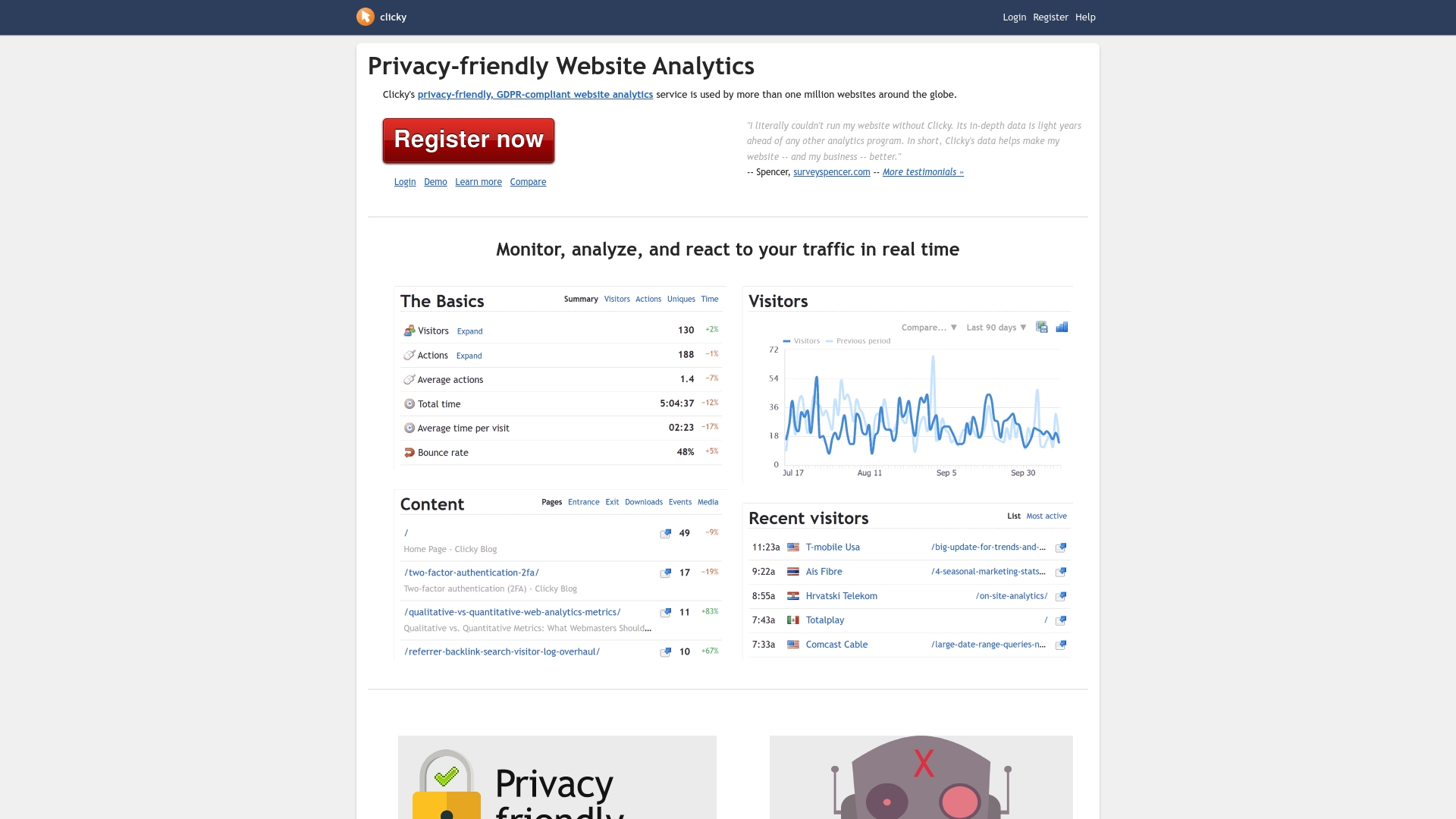
Clicky is a privacy-first, GDPR-compliant analytics service that delivers real-time visitor data and conversion insights without relying on tracking cookies or personal data. It’s built for teams and site owners who prioritize legal compliance and user privacy while still needing detailed, actionable analytics. The platform balances live monitoring, heatmaps, and security-focused features, making it a good fit for privacy-conscious sites that need immediate visibility. However, some advanced setups (like proxy-based ad-block tracking or optional full IP logging) require extra configuration.
Core Features
Clicky provides real-time data monitoring, goal tracking, and detailed visitor and action logs with anonymization by default. It includes heatmaps that can be viewed by page, visitor, or segment, plus security and anti-fraud measures with optional full IP address logging when explicitly needed for legitimate purposes. Additional capabilities include uptime monitoring with alerts and the ability to identify ad-block visitors via proxy tracking when configured. The emphasis is on delivering precise, timely insights while minimizing the collection of personal data.
Pros
- GDPR-compliant and privacy-friendly: Clicky avoids tracking cookies and personal data by default, making compliance straightforward for privacy-conscious sites.
- Comprehensive real-time analytics: The platform offers immediate visibility into traffic, goals, and visitor actions, which helps you react quickly to trends or issues.
- Ad-block visitor detection via proxy tracking: Clicky can monitor visitors who use ad blockers by routing requests through a proxy, preserving visibility where other tools fail.
- Security-focused features: Built-in anti-fraud measures and optional full IP address logging provide stronger protection and forensic capabilities when security requires it.
- Uptime monitoring from multiple global locations: Alerts from distributed locations help you detect and respond to outages faster.
Cons
- Proxy setup to track ad-block visitors can be complex: Implementing proxy-based tracking adds technical overhead and may require infrastructure changes or developer support.
- Optional full IP logging needs additional configuration: Enabling full IP address logging is not the default and demands careful handling to remain compliant and secure.
- Limited upfront pricing transparency: The website does not specify detailed pricing publicly, which makes cost comparisons harder without contacting the provider.
Who It’s For
Clicky is ideal for webmasters, digital marketers, SEO professionals, and website owners who must balance detailed, real-time analytics with strict privacy requirements. If your organization needs live traffic monitoring, conversion tracking, heatmap-driven UX insights, and stronger anti-fraud controls—but cannot accept tracking cookies—Clicky fits that niche well.
Unique Value Proposition
Clicky’s core differentiator is its combination of privacy-by-design and live analytics: you get near-instant visitor insights and conversion tracking without default personal data collection or cookie-based tracking. For teams that must meet GDPR obligations while preserving operational transparency, Clicky offers a focused alternative to cookie-reliant analytics platforms.
Real World Use Case
A privacy-conscious company uses Clicky to monitor traffic spikes in real time, analyze visitor behavior with heatmaps, and segment audiences for conversion optimization. When an outage occurs, uptime alerts from multiple global locations notify the site manager immediately, allowing a rapid response while preserving user privacy.
Pricing
Not specified on the webpage; typically involves a subscription or plan-based pricing model.
Website: https://clicky.com
StatCounter
At a Glance
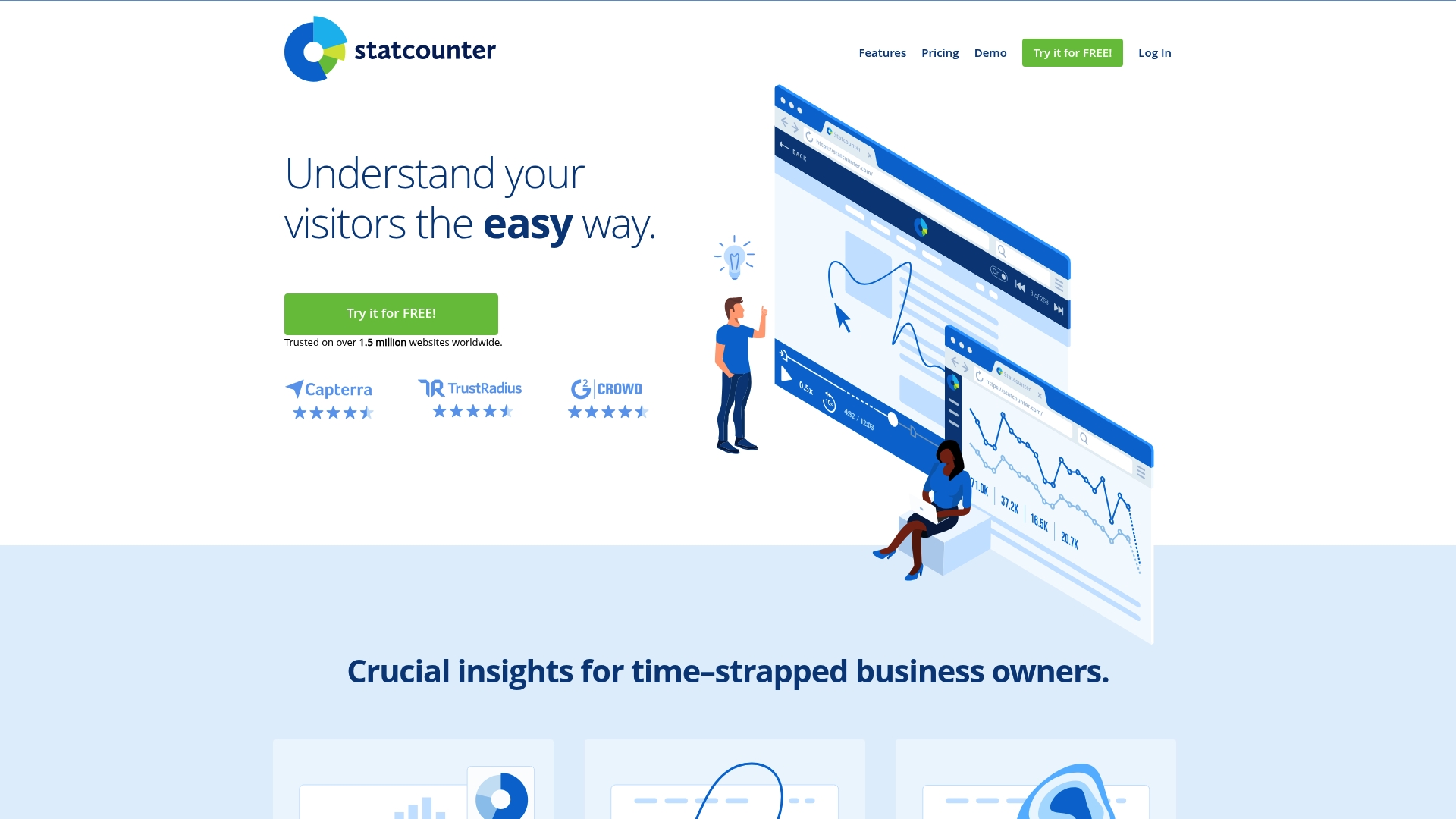
StatCounter is a lightweight, approachable web analytics tool trusted on over 1.5 million websites that focuses on real-time visitor insight and ease of use. If you need immediate visibility into who’s on your site, session replays and heatmaps without a steep learning curve, StatCounter delivers. It trades some of the depth and historical retention of enterprise platforms for simplicity and affordability, making it a practical choice for time-strapped site owners.
Core Features
StatCounter delivers real-time visitor feeds, session replay recordings, and visual heatmaps that show where users focus their attention. It tracks traffic sources, supports campaign tracking with UTM parameters, and integrates with Google Ads while offering click fraud detection. Additional capabilities include visitor labels and alerts, report filtering and dashboards, API access for custom development, and multiple plan options including a free tier and premium upgrades.
Pros
- Easy to set up and use: The platform is designed so non-experts can get actionable data quickly without a long onboarding process.
- Real-time insights and session replays: You can observe visitor behavior as it happens and replay sessions to see exact navigation patterns.
- Heatmaps and focused behavior data: Visual heatmaps complement recordings to show attention hotspots on pages, which helps prioritize UX fixes.
- Affordable plans for different needs: StatCounter offers a free basic plan and paid tiers that scale, making it accessible for small sites and growing businesses.
- Marketing-focused integrations: Direct integrations with Google Ads and campaign tracking tools help connect traffic to advertising performance and detect click fraud.
Cons
- Limited historical data on the free plan: The free basic tier stores less historical data than more robust analytics platforms, which can hamper long-term trend analysis.
- Advanced features often behind paywall: Useful capabilities like detailed heatmaps and session recordings may require upgrading to a paid plan, which adds cost.
- Less customizable reporting than enterprise tools: Users who need highly tailored reports or deep segmentation may find StatCounter’s reporting options somewhat basic compared with larger analytics suites.
Who It’s For
StatCounter is ideal for small to medium-sized business owners, marketers, and website administrators who want straightforward, immediate insights into visitor behavior without hiring an analyst. If you run landing pages, e-commerce stores, or campaigns and need a fast way to spot problems and optimize pages, StatCounter fits that workflow well.
Unique Value Proposition
StatCounter’s strength is blending real-time monitoring, session replay, and heatmaps into a single, easy-to-use package that’s affordable for smaller sites. It emphasizes speed and clarity over overwhelming detail, so you can find and fix issues quickly.
Real World Use Case
A small online retailer uses StatCounter to watch traffic spikes during promotions, replay sessions that abandoned at checkout, and consult heatmaps to identify confusing form fields—then iterates on landing pages to improve conversions.
Pricing
Free basic plan; paid plans starting from €9/month with additional features like session recordings, heatmaps, campaign tracking, and higher volume support.
Website: https://statcounter.com
Web Analytics and Language Processing Tools Comparison
This table provides a comparative overview of popular web analytics and language processing tools. Review their features, pros, cons, pricing, and suitability to determine which tool best fits your needs.
| Tool | Key Features | Pros | Cons | Pricing |
|---|---|---|---|---|
| Words at Scale | Language processing automation, scalability, integration capabilities | Designed for large-scale tasks, automation-focused, scalable infrastructure, complementary resources | Limited content on the public page | Pricing not specified |
| Google Analytics | Real-time data tracking, customizable reporting, Google Ads integration | Comprehensive data insights, free for basic features, seamless Google integration, user-friendly interface | Data sampling with large datasets, steep learning curve, privacy concerns | Free tier available |
| Matomo | Full data ownership, real-time reporting, no data sampling, privacy compliance | Full control over data, strong privacy protections, open source, GA importer | Requires technical setup for on-premise, potentially higher complexity than managed services | Starts at €29/month |
| Simple Analytics | Essential insights without cookies, GDPR compliance, AI chat assistance | Privacy-first design, clear dashboard, AI insights, free option | Limited data history on free plan, higher cost at scale, less feature depth | Free plan; paid plans start at $15/month |
| Clicky | Real-time visitor data, conversion insights, GDPR compliance, heatmaps | GDPR-compliant, comprehensive real-time analytics, proxy tracking for ad-block, security features | Complex proxy setup, optional IP logging needs configuration | Pricing not specified |
| StatCounter | Real-time insights, session replays, heatmaps, marketing-focused integrations | Easy to use, affordable, real-time insights, marketing integrations | Limited historical data on free plan, advanced features behind paywall, less customizable reporting | Free plan; paid plans start at €9/month |
Unlock the Full Potential of Your Blog Analytics
Struggling to turn your blog analytics into real SEO growth? The article on top free blog analytics tools highlights a common challenge: while analytics platforms show what readers do on your site, they rarely teach you how to actually grow your organic traffic. Many content creators find themselves staring at metrics without clear next steps to boost their rankings or reach a wider audience. If you have ever felt overwhelmed or uncertain about what your numbers mean for your SEO strategies, you are not alone.
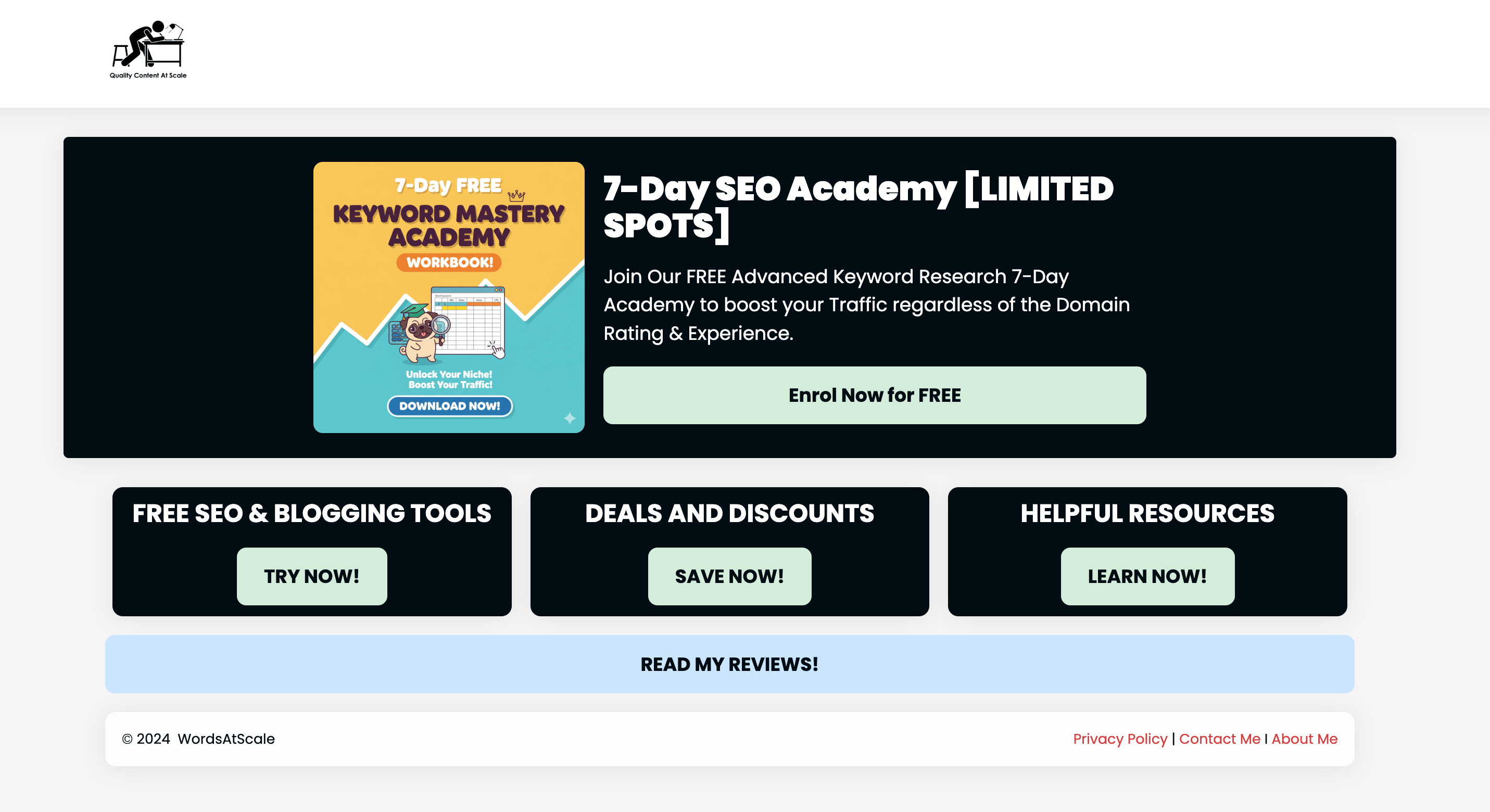
Take control of your blog’s future by pairing actionable analytics with in-depth training and free SEO resources. The free 7-day advanced keyword research academy at Words at Scale gives you step-by-step guidance to transform raw data into organic growth. Gain access to exclusive SEO tools and discounts that empower you to improve your performance regardless of your domain authority or experience. Spots in the academy are limited, so claim your place now at wordsatscale.com and stop letting valuable insights go to waste.
Frequently Asked Questions
What are the best free blog analytics tools available in 2025?
To find the best free blog analytics tools in 2025, consider options that provide essential metrics like visitor behavior, traffic sources, and engagement levels. Evaluate the features offered, ease of use, and compatibility with your blogging platform to make an informed choice.
How can I determine which free blog analytics tool is right for my site?
Start by identifying your specific analytics needs, such as tracking user behavior or measuring ad campaign effectiveness. Compare the features and user interfaces of different tools, and consider starting with a couple of options to see which one delivers the insights you need most effectively.
How do I set up a free blog analytics tool?
To set up a free blog analytics tool, typically, you’ll need to create an account with the chosen tool and add a tracking code or plugin to your blog’s code. Follow the specific setup instructions provided by the tool, which may involve copying a script and inserting it into the header of your site.
What metrics should I track with my free blog analytics tool?
Focus on tracking metrics such as page views, unique visitors, bounce rate, and average session duration to understand user engagement. Additionally, monitor traffic sources to discover where your visitors are coming from, which can help you optimize your content strategy.
Can I use multiple free blog analytics tools simultaneously?
Yes, you can use multiple free blog analytics tools at the same time to gain comprehensive insights into your blog’s performance. Just ensure you manage the setup for each tool properly to prevent any data conflicts or confusion about your website metrics.
How often should I analyze my blog analytics data?
Aim to review your blog analytics data at least once a month to identify trends, traffic changes, and engagement levels. Regular analysis (e.g., monthly) will help you adjust your content strategy effectively and spot opportunities for improvement.