Over 60 percent of american businesses report confusion about the boundaries between ethical and questionable SEO practices. The world of search engine optimization is packed with strategies that promise fast results, yet the line between fair play and risky shortcuts is often unclear. Knowing where Grey Hat SEO fits in can help marketers make informed choices about risk and reward, setting a foundation for smarter, safer search tactics.
Table of Contents
- Defining Grey Hat SEO And Core Concepts
- Types Of Grey Hat SEO Tactics
- How Grey Hat Strategies Work In Practice
- Legal And Ethical Implications Of Grey Hat SEO
- Risks, Penalties, And Common Pitfalls
Key Takeaways
| Point | Details |
|---|---|
| Understanding Grey Hat SEO | Grey Hat SEO balances between White Hat and Black Hat strategies, utilizing techniques that remain technically compliant yet ethically questionable. |
| Common Grey Hat Tactics | Tactics such as Private Blog Networks, expired domain acquisition, and review manipulation are frequently employed to gain search engine advantages. |
| Legal and Ethical Risks | Engaging in Grey Hat practices can expose marketers to potential legal liabilities and damage to their digital reputation. |
| Potential Consequences | The use of Grey Hat SEO can lead to algorithmic detection and severe penalties, resulting in traffic loss and diminished online credibility. |
Defining Grey Hat SEO and Core Concepts
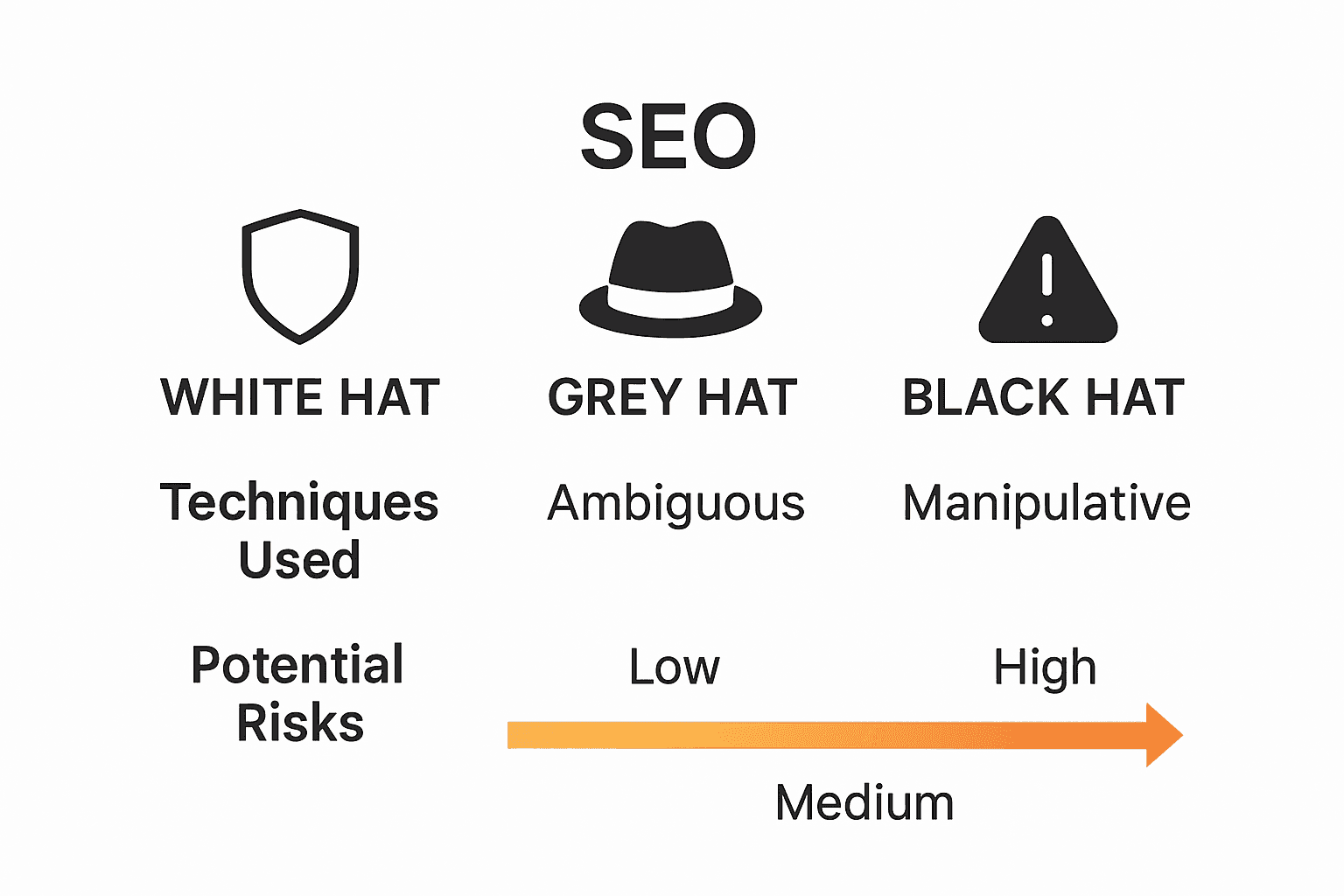
SEO strategies exist on a complex spectrum that ranges from strictly ethical white hat techniques to overtly manipulative black hat practices. Grey Hat SEO emerges as a nuanced approach that strategically navigates between these established boundaries. According to research from irjet.net, Grey Hat SEO combines elements of both White Hat and Black Hat SEO, presenting marketers with a calculated risk strategy for improving search engine rankings.
At its core, Grey Hat SEO represents techniques that technically do not violate search engine guidelines but exist in an ethical grey area. These methods push the boundaries of acceptable optimization without definitively crossing into prohibited practices. While not inherently malicious, Grey Hat techniques can potentially trigger search engine penalties if detected. Practitioners utilize strategies that may include methods like purchasing expired domains with existing authority, creating multiple microsites to funnel link equity, or developing content that skirts the edge of genuine value.
The key characteristics of Grey Hat SEO involve strategic manipulation that remains technically within permissible limits. Marketers employing these techniques understand they are walking a fine line between acceptable optimization and potential search engine repercussions. Typical Grey Hat approaches might involve:
- Purchasing high-quality expired domains with pre-existing backlink profiles
- Creating content specifically designed to capture search traffic without substantial original insight
- Utilizing automated content generation tools that produce marginally acceptable articles
- Developing network sites intended to cross-link and boost domain authority
While understanding SEO content creation strategies remains crucial, Grey Hat SEO demands careful consideration of potential risks versus potential ranking improvements. Marketers must continuously evaluate whether the potential short-term gains justify the potential long-term consequences of search engine penalties.
Types of Grey Hat SEO Tactics
In the evolving landscape of search engine optimization, Grey Hat SEO tactics represent a nuanced approach to improving website rankings. According to research from eflot.com, these tactics include sophisticated strategies like building Private Blog Networks (PBNs) to artificially inflate a website’s authority, submitting articles to multiple directories with slightly modified content, creating fake reviews to manipulate online reputation, and leveraging social media automation to boost engagement metrics.
Research from blackboxecom highlights additional complex Grey Hat techniques that marketers might employ to gain quick search engine advantages. These approaches often involve strategic manipulation of digital ecosystems, such as purchasing expired domains to leverage existing backlink profiles, implementing article spinning to generate multiple content variations, and employing social media spamming techniques to artificially increase social signals.
The most common Grey Hat SEO tactics can be categorized into several strategic approaches:
- Private Blog Networks (PBNs): Creating a network of websites specifically designed to generate backlinks
- Expired Domain Acquisition: Purchasing previously established domains with existing link equity
- Content Spinning: Algorithmically generating multiple versions of content to create diverse but similar articles
- Review Manipulation: Generating fake or biased reviews to influence online perception
- Social Signal Amplification: Using automated tools to artificially increase social media engagement
While exploring advanced SEO techniques for higher rankings provides valuable insights, marketers must understand that Grey Hat tactics represent a high-risk strategy. These methods can potentially deliver short-term ranking improvements but simultaneously expose websites to potential search engine penalties that could severely damage long-term digital visibility.
How Grey Hat Strategies Work in Practice
Grey Hat SEO strategies operate through sophisticated manipulation techniques that dance along the fine line between acceptable optimization and potential search engine violations. Cloaking emerges as one of the most complex implementation methods in this realm. According to research from arxiv.org, cloaking represents a technique where different content is presented to search engine crawlers versus actual users, strategically aiming to improve search rankings while potentially delivering unrelated or deceptive content to website visitors.
The practical execution of Grey Hat strategies involves multiple intricate approaches designed to exploit algorithmic vulnerabilities. Marketers utilizing these techniques typically create complex systems that appear legitimate on surface inspection but contain subtle manipulative elements. These methods might include creating multiple websites with interlinked content, developing microsites targeting specific keyword clusters, or generating content that technically meets search engine guidelines while minimizing genuine user value. The goal remains consistent: maximize search visibility through technically permissible yet ethically questionable methods.
Key practical implementation strategies for Grey Hat SEO include:
- Algorithmic Content Generation: Using advanced tools to produce marginally acceptable articles
- Tactical Link Acquisition: Purchasing or exchanging links through sophisticated networks
- Multilingual Content Spinning: Creating multiple content variations across different language versions
- Metadata Optimization: Crafting extremely precise meta descriptions and titles to maximize click-through potential
- Strategic Redirects: Implementing complex redirect chains that maintain link equity
Understanding advanced SEO techniques for higher rankings becomes crucial for marketers navigating these complex optimization strategies. While Grey Hat techniques can potentially yield short-term ranking improvements, they simultaneously expose websites to significant risks, requiring continuous monitoring and adaptive implementation to minimize potential search engine penalties.

Legal and Ethical Implications of Grey Hat SEO
The landscape of search engine optimization is fraught with complex ethical challenges that extend far beyond simple ranking strategies. Research from arxiv.org reveals that Grey Hat SEO practices can potentially undermine the fundamental integrity of search engines, particularly through sophisticated evasion attacks on machine learning-based classification systems. These tactics not only manipulate algorithmic processes but also expose users to potential risks by creating pathways for malicious content distribution.
According to additional research from arxiv.org, the legal implications of Grey Hat SEO become particularly pronounced when these strategies involve manipulating neural ranking models through imitation adversarial attacks. Such approaches raise significant ethical dilemmas by potentially creating unfair competitive environments and deliberately misleading both search engine algorithms and end users. The consequences can extend beyond technical violations, potentially triggering legal challenges related to intellectual property, consumer protection, and digital marketplace fairness.
Key ethical considerations in Grey Hat SEO include:
- User Deception: Creating content designed to mislead rather than inform
- Algorithmic Manipulation: Exploiting search engine vulnerabilities
- Competitive Integrity: Undermining fair ranking mechanisms
- Potential Legal Liability: Risking penalties from search engines and potential litigation
- Reputation Damage: Compromising long-term digital credibility
Writing SEO-friendly content for top rankings becomes crucial for marketers seeking to maintain ethical standards. While Grey Hat techniques might offer temporary advantages, the potential legal and reputational risks far outweigh any short-term gains, making transparent, value-driven content strategies the most sustainable approach for digital marketing success.
Risks, Penalties, and Common Pitfalls
Grey Hat SEO practitioners navigate a treacherous digital landscape where seemingly minor optimization tactics can trigger catastrophic consequences. According to research from Wikipedia, spamdexing represents a critical risk zone where deliberate manipulation of search engine indexes through techniques like aggressive link building and keyword stuffing can result in severe penalties, including dramatic ranking drops or complete website deindexing.
The potential consequences of Grey Hat SEO extend beyond immediate search ranking penalties. Wikipedia’s research highlights how practices like article spinning generate low-quality, algorithmically generated content that not only frustrates readers but also exposes websites to substantial search engine scrutiny. These techniques create a precarious digital environment where short-term ranking gains can rapidly transform into long-term visibility catastrophes, potentially destroying years of carefully developed online reputation.
Key risks and potential pitfalls of Grey Hat SEO strategies include:
- Algorithmic Detection: Advanced search engine algorithms continuously evolve to identify manipulative tactics
- Reputation Destruction: Losing credibility with both search engines and target audiences
- Traffic Collapse: Sudden and potentially irreversible organic traffic reduction
- Manual Penalties: Direct interventions from search engine quality teams
- Competitive Disadvantage: Falling behind ethically practicing competitors
Writing SEO-friendly content for top rankings becomes paramount for marketers seeking sustainable digital growth. The most successful strategies prioritize genuine value creation over algorithmic manipulation, recognizing that authentic, user-focused content represents the most reliable path to long-term search engine success.
Master Ethical SEO Strategies with Confidence
Navigating the fine line between Grey Hat SEO risks and sustainable growth can feel overwhelming. This guide highlights how tactics like expired domain acquisition or content spinning may offer short-term gains but carry serious penalties. If you want to avoid these pitfalls while achieving higher search rankings, understanding how to create authentic, effective content is essential. Explore proven methods that prioritize long-term visibility without risking your website’s credibility.
Boost your skillset with expert insights from our Copywriting – WordsAtScale resources and enhance your workflow using powerful Tools – WordsAtScale.

Take control of your SEO journey today by visiting WordsAtScale and gain access to free training, advanced keyword research, and tools designed to elevate your rankings safely. Don’t wait until penalties hurt your traffic—start mastering ethical SEO techniques now.
Frequently Asked Questions
What is Grey Hat SEO?
Grey Hat SEO refers to techniques that exist between ethical, white hat practices and unethical, black hat practices. These methods technically do not violate search engine guidelines but reside in an ethical grey area, potentially leading to penalties if detected.
What are some common Grey Hat SEO tactics?
Common Grey Hat SEO tactics include purchasing expired domains with existing authority, creating Private Blog Networks (PBNs), and using content spinning techniques to generate multiple versions of content for better search visibility.
What are the risks associated with Grey Hat SEO?
The risks of Grey Hat SEO include algorithmic detection by search engines, potential loss of reputation, sudden drops in organic traffic, and manual penalties imposed by search engine quality teams.
How can I avoid penalties when using Grey Hat SEO techniques?
To avoid penalties, ensure that your SEO practices prioritize genuine value creation, continuously monitor algorithm updates, and be cautious of techniques that may be perceived as manipulative or deceptive.