To choose a keyword research tool, define the job first, then score each tool on eight criteria: data source, difficulty method, buyer-fit scoring, caps, seat costs, billing model, AI search data and exports. Price matters less than whether it tells you which keywords are worth a page.
 By Vlad Ivanov · Last updated: October 2026
Key Takeaways
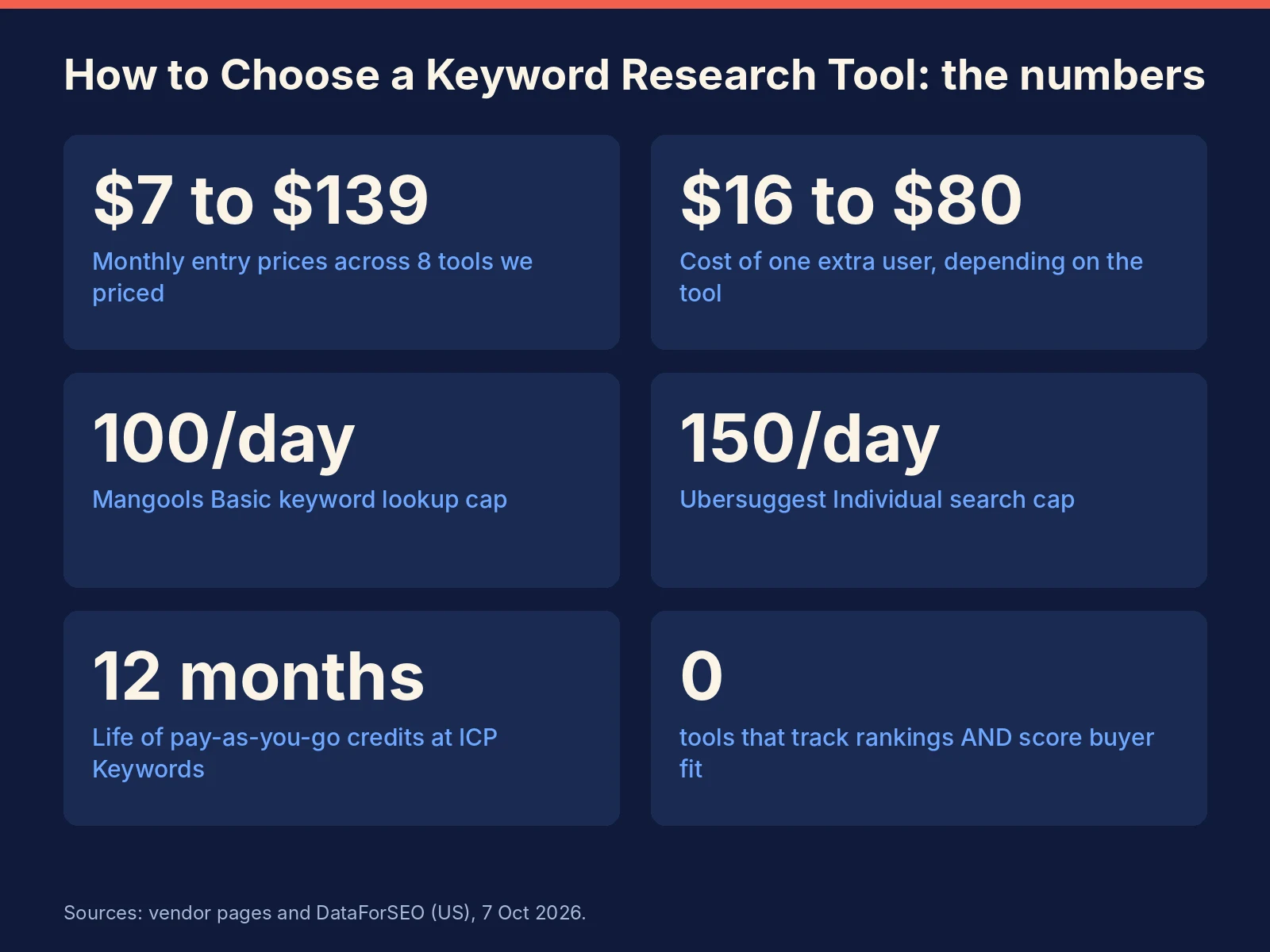
- Entry prices across the 9 tools we checked on 7 October 2026 ran from free (Google Keyword Planner) and $7/mo (Keywords Everywhere) to $139/mo (Semrush).
- Extra users range from $16 (SE Ranking) to $80/mo (Ahrefs Advanced), so seat costs can matter more than the plan price (Ahrefs pricing).
- Daily caps vary: Mangools Basic allows 100 keyword lookups per 24 hours, Ubersuggest Individual 150 searches a day (Mangools).
- Ahrefs KD counts referring domains to the top 10 and ignores on-page factors, by its own definition (Ahrefs).
- When we asked ChatGPT how to choose a keyword research tool, it listed volume, difficulty, intent, competitor and SERP analysis, and cited ahrefs.com and Google support pages.
- None of the tools we priced both tracks rankings and scores keywords by buyer fit, so many teams pair two tools.
What job do you need the tool for?
Answer this first, because it changes which criteria matter. New niche or affiliate site: SERP weak spots and price matter most; see keyword research for zero-DR sites. B2B or SaaS pipeline: buyer fit and comparison keywords matter most; see B2B keyword research. Client SEO or an agency: seats, caps, rank tracking and exports matter most.
What are the 8 criteria to judge a keyword tool on?
| # | Criterion | Question to ask | Red flag |
|---|---|---|---|
| 1 | Data source | Where do the keyword ideas come from: a crawled database, autocomplete, People Also Ask, Reddit, YouTube comments, AI answers? | Only one source, and it is the same database everyone exports |
| 2 | Difficulty method | What does the KD score count, and does the tool show the live top 10? | A KD number with no way to see who ranks |
| 3 | Fit scoring | Can it tell your buyers from students, job seekers and competitors? | Volume-first sorting only |
| 4 | Daily caps | How many lookups per day or month on the plan you would buy? | Caps hidden until checkout |
| 5 | Seats | What does each extra user cost, and is there a cap? | Entry plan with no extra seats |
| 6 | Billing model | Monthly, annual only, credits, or one-time? | Annual only for a tool you use in bursts |
| 7 | AI search data | Does it show what AI assistants search or cite, as a keyword source? | “AI” that only means an AI writer |
| 8 | Exports and API | CSV, clusters, API access, saved runs? | Paying again to reload old research |
How do the main tools score on those criteria?
All prices and limits below were read from each vendor’s page on 7 October 2026. “Not listed” means the pricing page did not state it.
| Tool | Entry price | Extra user | Caps on entry plan | Billing | Unique strength |
|---|---|---|---|---|---|
| Semrush | $139/mo | From $45/mo | 500 tracked keywords | Monthly or annual | Breadth incl. PPC |
| Ahrefs | $129/mo Lite ($29 Starter) | $40 to $80/mo | 750 tracked keywords | Monthly or annual | Backlinks, Traffic Potential |
| SE Ranking | $129/mo | From $16 | 2,000 tracked keywords | Monthly or annual | Cheap seats |
| Mangools | $37.70/mo | None on Basic | 100 lookups/24h | Annual shown | Ease of use |
| Ubersuggest | $16/mo | 2+ users on Business | 150 searches/day | Annual, lifetime option | Price |
| LowFruits | $25 pack | Not listed | Credits | Packs or yearly | SERP weak spots |
| ICP Keywords | $25 pack or $29.90/mo | Not listed | Credits | Packs or monthly | Buyer-fit scoring, Reddit/YouTube/AI sources |
| Keywords Everywhere | $7/mo ($84/yr) | 3 seats on Silver | Credits | Annual | Volume in the browser |
| Google Keyword Planner | Free | n/a | Ranges without ad spend | Free | Google’s own data |
Detailed comparisons: Semrush alternatives, Ahrefs alternatives, Ahrefs vs Semrush and keyword tools without a subscription.
Which questions do vendors avoid on their pricing pages?
- What does one extra user cost on the plan I would actually buy?
- What happens when I hit the daily cap: blocked, throttled or charged?
- Do unused credits roll over or expire?
- Can I reload past research without paying for the data again?
- Is the “AI” feature a keyword source, brand monitoring, or a writer?
Ask them in a trial or support chat before you pay. The answers often decide the choice.
How do you test a keyword tool in a free trial?
- Pick 10 keywords you already know: some you rank for, some you failed on.
- Run them through each trial tool and compare volume, KD and the SERP view against what you saw happen.
- Check one keyword your buyers use but nobody searches much. Does the tool surface it or bury it?
- Export the results. Is the file usable without clean-up?
A tool that ranks your failed keywords as “easy” will do it again. Read why keyword difficulty misleads for what to look for.
Where does ICP Keywords fit?
ICP Keywords scores well on criteria 1, 3, 6, 7 and 8: seven discovery sources including Reddit, YouTube comments and AI fan-out queries, buyer-fit scoring, credits or monthly billing, and saved runs that reload without new charges. It does not track rankings or backlinks, so on criterion 2 it relies on a live top-3 domain rating check rather than a backlink index. If you need rank tracking, pair it with a suite. More on the AI side in ChatGPT fan-out queries.
ICP Keywords: 100 free credits, 7 days, no card. See whether buyer-fit scoring ranks your keywords the way your results did.
Frequently asked questions
How do I choose a keyword research tool?
Start from the job: building a new site, growing a B2B pipeline, or running client SEO. Then score tools on where their keywords come from, how they judge difficulty and fit, daily caps, seat costs, billing model, AI search data and export options.
What is the most important feature in a keyword research tool?
How it decides which keywords are worth it. Volume and difficulty are table stakes. What separates tools is whether they check the live SERP for weak results and whether they can tell buyers from browsers.
Are free keyword research tools good enough?
For one small site, often yes: Google Keyword Planner, Search Console and free tiers cover the basics. Paid tools save time on SERP analysis and give competitor data free tools do not.
Should I pay monthly or buy credits?
If you research in bursts, credits or a one-time app cost less. If you use the tool daily or need rank tracking, a subscription is better value.
How many users do I need to pay for?
Check this before buying. Extra users cost from $16 (SE Ranking) to $80 a month (Ahrefs Advanced), and some entry plans cap extra users or include none.
Do keyword tools show the same search volume?
No. Each tool models volume differently. Pick one as your reference, and use the live SERP to make the final call.
Do I need AI search data in a keyword tool?
Increasingly, yes, if you sell to buyers who ask ChatGPT for shortlists. Look for fan-out query data or AI visibility tracking, and check whether it is a keyword source or only brand monitoring.
Vlad Ivanov runs the Words At Scale YouTube channel (26,000+ subscribers) and nine Search Console-verified sites, and built ICP Keywords, a keyword research tool for B2B and niche sites. LinkedIn