Most american websites never unlock their full search potential because they underestimate the power of thoughtful keyword use. Search engines rely on keywords as their primary signal for connecting content with real user questions. With over 8.5 billion searches made every day, mastering keyword strategy can transform both visibility and online authority. Understanding how keywords actually work gives you a real advantage in reaching your audience and building smarter SEO foundations.
Table of Contents
- Defining Keywords And Their SEO Importance
- Types Of Keywords And Their Strategic Uses
- How Search Engines Interpret Keywords
- Effective Keyword Research Techniques
- Common Keyword Mistakes To Avoid
Key Takeaways
| Point | Details |
|---|---|
| SEO Foundation | Keywords are vital for connecting content with user intent, helping search engines understand and rank web pages effectively. |
| Keyword Types | Utilize various keyword types such as short-tail, long-tail, and geo-targeted to reach diverse audience segments and drive targeted traffic. |
| Research Techniques | Employ comprehensive keyword research techniques, including competitor analysis and understanding user intent, to optimize search performance. |
| Avoid Pitfalls | Steer clear of keyword stuffing and focus on contextual relevancy to enhance user experience and avoid penalties from search engines. |
Defining Keywords and Their SEO Importance
Keywords are the fundamental building blocks of search engine optimization, serving as critical communication bridges between content creators and search engines. According to communicationmgmt, keywords are “specific words or phrases that encapsulate the main topics of content,” playing a pivotal role in helping search engines understand and rank web pages appropriately.
At their core, keywords represent the precise language users input when searching for information online. These strategic terms act as navigational signposts that guide search engines toward understanding the context, relevance, and purpose of web content. When strategically selected and implemented, keywords enable websites to match user intent more effectively, increasing the probability of appearing in relevant search results.
The science behind keyword effectiveness extends beyond simple word selection. en highlights the concept of keyword density, which measures the percentage of times a keyword appears relative to the total word count on a webpage. This metric significantly influences a page’s perceived relevance and potential search engine ranking. Smart keyword integration requires a delicate balance – using terms naturally without overwhelming the content or appearing manipulative.
To maximize keyword potential, digital creators must focus on several critical strategies:
- Select keywords that authentically represent content
- Understand user search intent behind specific phrases
- Maintain natural, readable language
- Avoid keyword stuffing or artificial repetition
- Prioritize user experience over mechanical optimization
By understanding keyword research thoroughly, you can transform these linguistic signposts into powerful tools for connecting with your target audience and improving online visibility.
Types of Keywords and Their Strategic Uses
Keyword research is a nuanced art that involves understanding the diverse landscape of search terms users employ to find information online. en highlights that keyword research encompasses “identifying and analyzing search terms” across multiple strategic categories, each serving unique purposes in search engine optimization.
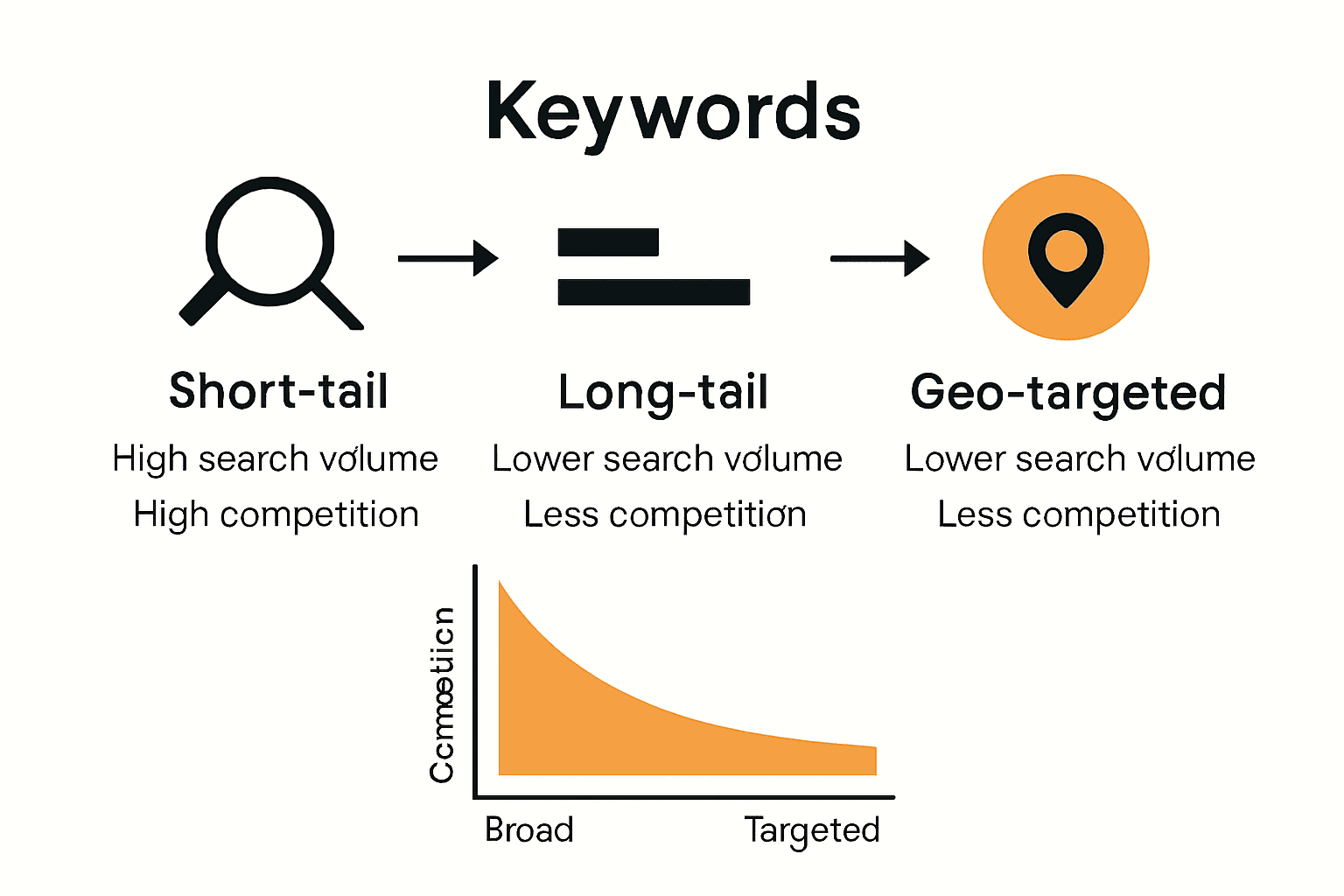
The primary categories of keywords include short-tail, long-tail, and geo-targeted keywords. Short-tail keywords are broad, typically one to two words long, generating high search volumes but facing intense competition. Long-tail keywords are more specific, often containing three or more words, which allows for more targeted content and typically lower competition. Geo-targeted keywords focus on location-specific searches, enabling businesses to capture regional audience segments.
en introduces the advanced concept of keyword clustering, an sophisticated SEO technique that groups related keywords into interconnected clusters. This approach enables content creators to address multiple related search queries simultaneously, enhancing the comprehensiveness and relevance of their content. By strategically organizing keywords, marketers can create more holistic content that speaks to broader user intents and search patterns.

To effectively leverage different keyword types, digital marketers should consider these strategic approaches:
- Match keywords to specific stages of user intent
- Balance high-volume and niche search terms
- Integrate long-tail keywords for precision targeting
- Use keyword clusters to create comprehensive content
- Continuously refine keyword strategies based on performance metrics
For a deeper understanding of advanced keyword research techniques, explore our guide on types of keyword research to unlock more sophisticated SEO strategies.
How Search Engines Interpret Keywords
Search engines have developed sophisticated mechanisms for decoding and understanding the complex language of keywords. en explains that an index term, fundamentally a keyword, “captures the essence of a document’s topic,” serving as a critical bridge between user queries and relevant content. This interpretation process goes far beyond simple word matching, involving intricate algorithms that analyze context, intent, and semantic relationships.
Semantic analysis plays a pivotal role in how search engines comprehend keywords. Modern search algorithms no longer rely solely on exact word matches but instead examine the broader meaning and relationships between terms. They consider factors like word proximity, synonyms, related concepts, and the overall contextual landscape of the content. This means that search engines can now understand nuanced queries, distinguishing between different potential meanings of the same word and delivering more precise results.
en demonstrates this advanced interpretation through platforms like Google Scholar, which “indexes the full text or metadata of scholarly literature, utilizing keywords to facilitate the discovery and ranking of academic content.” This approach illustrates how sophisticated keyword interpretation has become, moving beyond basic indexing to understanding complex informational hierarchies and relationships between different pieces of content.
Key aspects of how search engines interpret keywords include:
- Analyzing user intent behind search queries
- Evaluating contextual relevance
- Understanding semantic relationships between words
- Assessing content quality and depth
- Considering user engagement metrics
To gain deeper insights into maximizing your keyword strategy, explore our SEO guide for beginners, which breaks down the intricate world of search engine algorithms and keyword optimization.
Effective Keyword Research Techniques
en defines effective keyword research as a strategic process involving “brainstorming and utilizing tools to identify relevant search terms,” with a critical focus on discovering keywords that balance high search volume with low competition. This approach transforms keyword research from a mere technical exercise into a nuanced art of understanding user intent and digital market dynamics.
Competitive keyword analysis forms the cornerstone of successful research strategies. This involves deep examination of search terms through multiple lenses: monthly search volumes, difficulty scores, current ranking competitors, and potential traffic opportunities. Marketers must look beyond surface-level metrics, diving into the underlying user motivations and contextual meanings that drive search behaviors. Understanding these subtle dynamics allows for more precise and targeted keyword selection that resonates with specific audience segments.
arxiv highlights a sophisticated “multi-level computational framework” for keyword optimization, emphasizing that modern keyword research transcends simple volume and competition metrics. Advanced practitioners now consider complex factors like semantic relevance, user intent, and potential conversion potential when selecting keywords. This computational approach enables more intelligent, data-driven keyword strategies that align closely with audience needs and search engine algorithms.
Key techniques for effective keyword research include:
- Conduct comprehensive competitor keyword analysis
- Utilize advanced keyword research tools
- Analyze search intent behind keywords
- Explore long-tail keyword variations
- Monitor keyword performance consistently
- Understand user search psychology
To accelerate your keyword research skills, explore our tutorial on finding keywords for better SEO results, which provides actionable strategies for uncovering high-potential search terms.
Common Keyword Mistakes to Avoid
Keyword optimization is a delicate balance, and digital marketers frequently stumble into pitfalls that can dramatically undermine their SEO efforts. en warns about the critical danger of keyword stuffing, a practice that can “harm user experience and SEO rankings” by making content appear manipulative and unnatural. This strategy not only repels readers but also triggers search engine penalties that can devastate a website’s organic visibility.
Understanding optimal keyword density is crucial for maintaining content quality. marketingjournal recommends maintaining a precise balance, suggesting “an ideal keyword density of 3% – 7% for main keywords and 1% – 2% for secondary keywords.” Exceeding these percentages signals potential keyword manipulation to search algorithms, potentially resulting in ranking downgrades or content devaluation. Smart marketers focus on creating contextually rich, naturally flowing content that integrates keywords seamlessly rather than forcibly inserting them.
Beyond density concerns, several strategic keyword mistakes can sabotage SEO performance. Many content creators mistakenly target only high-volume keywords, neglecting long-tail variations and specific user intents. They often ignore the critical nuances of semantic search, failing to understand that modern search engines prioritize contextual relevance over exact match terminology. This narrow approach limits content discoverability and prevents meaningful audience connection.
Keyword strategy pitfalls to vigilantly avoid include:
- Forcing keywords into unnatural sentence structures
- Targeting only broad, high-competition keywords
- Neglecting user intent behind search queries
- Ignoring semantic search principles
- Using identical keywords across multiple pages
- Failing to update keyword strategies regularly
For comprehensive guidance on avoiding these common traps, explore our tutorial on finding keywords for better SEO results, which provides actionable strategies for intelligent keyword optimization.
Elevate Your SEO with Expert Keyword Strategies
Mastering the role of keywords is essential to overcome challenges like keyword stuffing, poor search intent targeting, and ineffective keyword research. This guide highlights how understanding concepts like keyword density, long-tail keywords, and semantic relevance can transform your content’s visibility. If you are struggling to connect with your audience or rank on search engines despite your efforts, it is time to refine your approach with proven strategies.

Unlock the full potential of your SEO with the free 7-day advanced keyword research academy at wordsatscale.com. Gain exclusive access to expert training and practical tools designed to help you avoid common keyword mistakes and craft content that search engines love. Start improving your rankings and driving real organic traffic today by joining our comprehensive SEO guide for beginners and exploring how to find keywords for better SEO. Take action now to secure your spot and transform your keyword strategy into measurable success.
Frequently Asked Questions
What are keywords in SEO?
Keywords are specific words or phrases that encapsulate the main topics of content, helping search engines understand and rank web pages appropriately based on user queries.
How does keyword density affect SEO?
Keyword density measures the percentage of times a keyword appears relative to the total word count on a webpage. Optimal keyword density is important for maintaining relevance without appearing manipulative to search engines.
What is the difference between short-tail and long-tail keywords?
Short-tail keywords are broad and typically consist of one to two words, generating high search volumes but with more competition. Long-tail keywords are more specific, usually three or more words, which allows for targeted content and generally features lower competition.
What common mistakes should be avoided in keyword optimization?
Common mistakes include keyword stuffing, targeting only high-volume keywords, neglecting user intent, and failing to maintain natural keyword integration in content.