
Most people searching online never realize that Google’s quality decisions hinge on three key factors: expertise, authoritativeness, and trustworthiness. These elements, known as E-A-T, set the foundation for content that outperforms the competition and earns lasting credibility. Knowing that Google processes over 5 billion searches each day, understanding E-A-T can make the difference between getting found or fading away. This guide explains what E-A-T really means and how it shapes your content’s success.
Table of Contents
- Defining E-A-T: Expertise, Authoritativeness, Trustworthiness
- Key Elements Shaping Google’s E-A-T Evaluation
- How E-A-T Influences Content Rankings
- E-A-T Requirements for Different Website Types
- Common E-A-T Mistakes and How to Avoid Them
Key Takeaways
| Point | Details |
|---|---|
| Understanding E-A-T | E-A-T encompasses Expertise, Authoritativeness, and Trustworthiness, crucial for Google’s content evaluation and SEO ranking. |
| Focus on Content Quality | High-quality, comprehensive content that accurately addresses user needs is essential for enhancing E-A-T and improving search visibility. |
| Author and Website Credibility | Establishing clear author credentials and transparent website practices significantly boosts perceived authority and trust. |
| Avoid E-A-T Pitfalls | Key mistakes to avoid include anonymous authorship, poor content quality, and lacking technical trust signals, which undermine credibility and rankings. |
Defining E-A-T: Expertise, Authoritativeness, Trustworthiness
In the complex world of search engine optimization, E-A-T represents a critical framework that Google uses to evaluate the quality and credibility of online content. Standing for Expertise, Authoritativeness, and Trustworthiness, E-A-T is not just another SEO buzzword but a fundamental assessment of how search engines determine content value.
At its core, Expertise refers to the depth of knowledge and skill demonstrated by content creators in their specific field. This doesn’t necessarily mean having advanced academic credentials, but rather showing genuine understanding and practical insight. For instance, a food blogger sharing personal recipes with detailed instructions and clear techniques demonstrates expertise differently than a scientific journal article.
The Authoritativeness component examines the reputation of both the content creator and the website publishing the content. This means establishing credibility through multiple signals:
- Recognized credentials in the industry
- Professional qualifications
- Consistent high-quality content production
- Citations and references from other respected sources
- Clear author bios and professional backgrounds
Trustworthiness focuses on the reliability, transparency, and safety of the content and website. Search engines evaluate this through several key factors like secure website connections (HTTPS), clear contact information, transparent business practices, accurate information, and positive user experiences. A website that provides accurate information, protects user data, and maintains clear communication builds substantial trust with both users and search algorithms.
Understanding E-A-T isn’t just about impressing search engines. It’s about creating genuinely valuable content that serves your audience’s needs, answers their questions comprehensively, and establishes your brand as a reliable source of information in your niche. By consistently demonstrating expertise, building authority, and maintaining trust, you’ll not only improve your search rankings but also create meaningful connections with your audience.
Key Elements Shaping Google’s E-A-T Evaluation
Understanding the intricate mechanisms behind Google’s E-A-T evaluation requires a deep dive into the nuanced factors that determine content credibility. Moccu highlights that Google’s assessment goes far beyond surface-level content analysis, considering multiple sophisticated signals that collectively paint a comprehensive picture of a website’s reliability and value.
The first critical element is Content Depth and Quality. Google’s algorithms scrutinize whether content provides comprehensive, accurate, and meaningful information. This means your content should:
- Answer user queries completely
- Provide unique insights
- Include verifiable information
- Demonstrate original research or perspective
- Offer clear, actionable guidance
The second pivotal factor is Author and Website Credentials. Search engines meticulously evaluate the background, qualifications, and professional standing of content creators. Professional certifications, industry recognition, and a track record of producing high-quality content significantly influence E-A-T scoring. A neurosurgeon writing about medical procedures will naturally carry more authority than an anonymous blogger discussing complex medical topics.
Technical Signals also play a substantial role in E-A-T evaluation. Websites must demonstrate technical reliability through:
- Secure HTTPS connections
- Clear, accessible contact information
- Up-to-date content
- Mobile responsiveness
- Fast loading speeds
- Minimal intrusive advertising
Finally, User Experience and Engagement Metrics provide crucial insights into content credibility. Google analyzes how users interact with your content, considering factors like time spent on page, bounce rates, and user comments. High engagement signals that your content genuinely serves user needs, thereby enhancing your E-A-T profile. By consistently delivering valuable, trustworthy content that prioritizes user experience, you can progressively improve your standing in Google’s complex evaluation framework.

How E-A-T Influences Content Rankings
In the intricate world of search engine optimization, E-A-T plays a pivotal role in determining how content ranks on Google’s search results. While there’s no direct numerical score for E-A-T, it fundamentally shapes the algorithmic evaluation of web content, influencing visibility and search positioning in profound ways.
The ranking impact begins with content relevance and quality. Google’s sophisticated algorithms assess whether your content genuinely addresses user intent, providing comprehensive and valuable information. High E-A-T content demonstrates deep understanding, offers unique insights, and goes beyond surface-level explanations. This means creating content that not only answers user questions but anticipates and explores related nuances that demonstrate true expertise.
Ranking signals directly tied to E-A-T include several critical factors:
- Depth and comprehensiveness of content
- Accuracy of information
- Credentials of content creators
- Website reputation and domain authority
- User engagement metrics
- Technical website performance
- Quality and quantity of external references
The most significant E-A-T impact occurs in YMYL (Your Money Your Life) categories like health, finance, legal advice, and news. In these sensitive domains, Google applies stricter E-A-T evaluation, prioritizing content from recognized experts and authoritative sources. A medical article written by a board-certified physician will inherently rank higher than generic health advice from an anonymous blogger. This approach protects users by ensuring critical information comes from credible, knowledgeable sources.
Ultimately, improving E-A-T is about building genuine credibility. It’s not a checkbox exercise but a holistic approach to creating meaningful, trustworthy content that serves your audience’s genuine needs. By consistently demonstrating expertise, maintaining transparent authorship, and delivering high-quality, verifiable information, you’ll naturally improve your content’s ranking potential. Google’s algorithms are designed to reward websites that prioritize user experience and substantive, reliable information.
E-A-T Requirements for Different Website Types
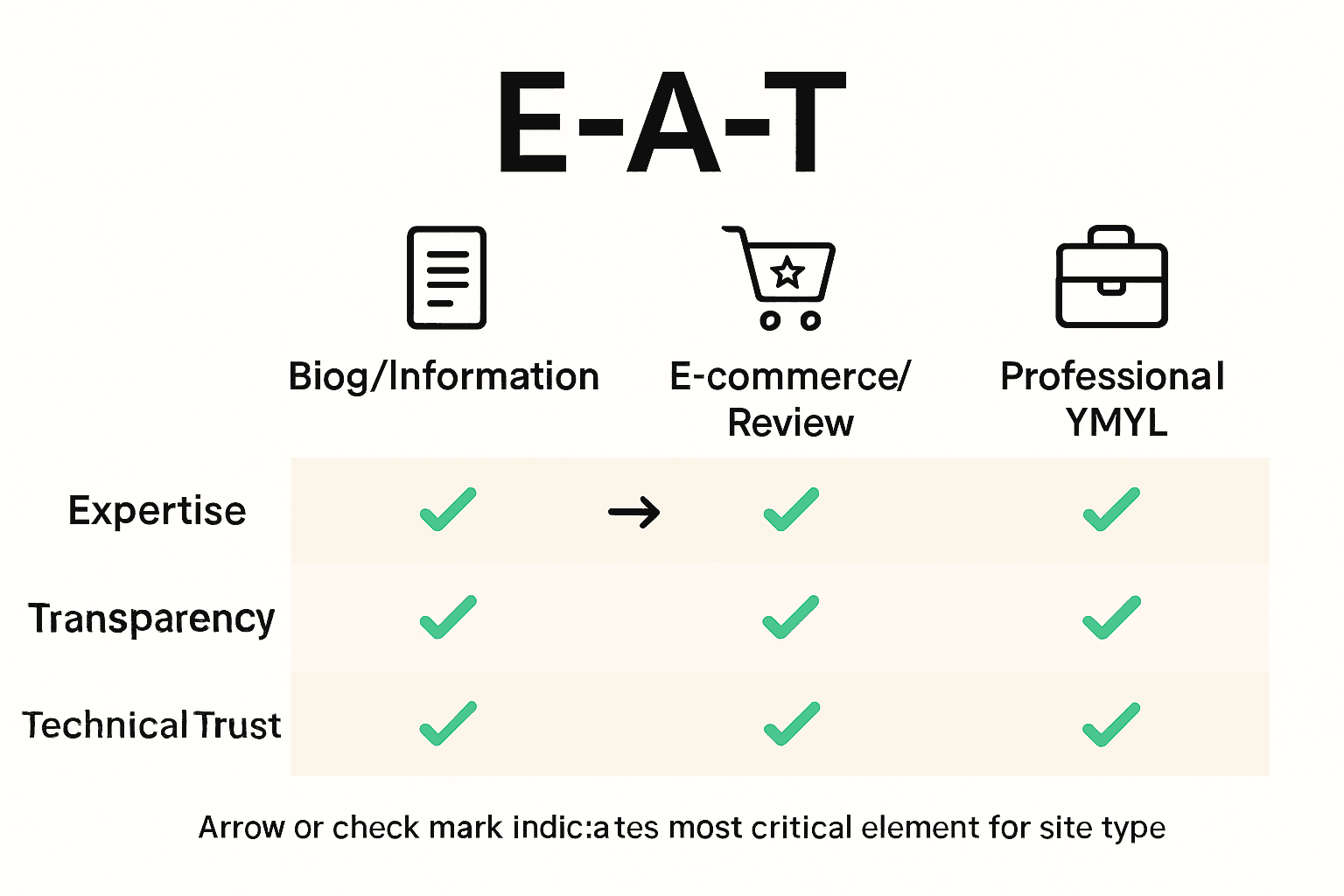
E-A-T is not a one-size-fits-all concept. Different website types face unique challenges and requirements when it comes to establishing credibility and expertise. Understanding these nuanced expectations helps website owners strategically develop content that meets Google’s sophisticated evaluation criteria.
Informational and Blog Websites
For informational and blog websites, expertise is demonstrated through comprehensive, well-researched content. This means going beyond surface-level information and providing:
- Detailed, original insights
- Citations from reputable sources
- Clear author credentials
- In-depth analysis of topics
- Regular content updates
E-Commerce and Product Review Sites
E-commerce platforms and product review websites must balance commercial intent with genuine user value. Key E-A-T requirements include:
- Transparent product information
- Honest, balanced reviews
- Clear disclosure of affiliate relationships
- Detailed product specifications
- User-generated content and verified reviews
Professional Services and YMYL Websites
Websites in Your Money Your Life (YMYL) categories like healthcare, finance, and legal services face the most stringent E-A-T requirements. These sites must provide:
- Verified professional credentials
- Expert-written content
- Transparent contact information
- Secure website infrastructure
- Regular content verification
- Clear professional affiliations
Understanding and implementing these type-specific E-A-T strategies allows websites to not just meet algorithmic requirements, but genuinely serve their audience’s needs. By prioritizing expertise, transparency, and user value, websites can build long-term credibility that transcends simple search engine optimization tactics.
Common E-A-T Mistakes and How to Avoid Them
Navigating the complex landscape of E-A-T requires understanding not just what to do, but what critical mistakes can undermine your content’s credibility. Many website owners inadvertently sabotage their search rankings by overlooking fundamental aspects of expertise, authoritativeness, and trustworthiness.
Lack of Author Transparency
One of the most common E-A-T pitfalls is anonymous or poorly documented content. Websites that fail to provide clear author information create immediate credibility concerns. To combat this:
- Create comprehensive author bios
- Include professional credentials
- Link to verified professional profiles
- Use real names and photographs
- Highlight specific expertise and qualifications
Content Quality Degradation
Consistent, high-quality content is crucial. Common mistakes that erode E-A-T include:
- Thin, superficial content
- Outdated information
- Lack of original research
- Poor grammar and spelling
- Inconsistent publishing schedule
- Rehashing existing content without adding value
Technical Trust Signals
Websites often overlook critical technical elements that signal trustworthiness:
- Unsecured HTTP connections
- Lack of clear contact information
- Missing privacy policies
- Poor mobile responsiveness
- Slow page loading speeds
- Intrusive advertisements
Avoiding these E-A-T mistakes requires a holistic approach. It’s not about gaming the system, but genuinely creating valuable, transparent, and reliable content that serves your audience’s needs. By prioritizing expertise, maintaining technical integrity, and consistently delivering high-quality information, you’ll naturally improve your website’s credibility and search performance.
Elevate Your E-A-T and Win at SEO Today
Struggling to prove your website’s expertise, authoritativeness, and trustworthiness? The concept of E-A-T can feel overwhelming when trying to boost your search rankings and gain user trust. You want clear guidance and practical tools to create content that genuinely stands out and meets Google’s high standards — without wasting time or resources.
At Words at Scale, we understand the challenge of turning complex SEO principles like E-A-T into actionable results. Our free 7-day advanced keyword research academy and suite of SEO tools help marketers, bloggers, and website owners craft authoritative content that drives organic traffic even if you’re just starting out. From mastering keyword strategies to improving your website’s technical trust signals, we provide exactly what you need to build lasting credibility.
Don’t let your content get lost in the crowd. Join the Words at Scale academy now and start transforming your SEO approach with proven strategies that align perfectly with Google’s E-A-T criteria. Secure your spot today and take the confident step toward higher rankings and real audience engagement.
Frequently Asked Questions
What does E-A-T stand for in SEO?
E-A-T stands for Expertise, Authoritativeness, and Trustworthiness. It is a framework used by Google to evaluate the quality and credibility of online content.
Why is E-A-T important for SEO?
E-A-T is crucial for SEO because it influences how Google ranks content. Websites with high E-A-T are more likely to be deemed credible and valuable, leading to better visibility in search results.
How can I improve my website’s E-A-T?
You can improve your website’s E-A-T by consistently creating high-quality content, providing clear author credentials, maintaining technical integrity (like secure connections), and ensuring a positive user experience.
What types of websites need to focus on E-A-T the most?
Websites in Your Money Your Life (YMYL) categories, such as healthcare, finance, and legal services, need to prioritize E-A-T the most, as these topics require higher credibility and accuracy to protect user interests.
Recommended
- Why SEO Matters: Complete Guide for Digital Success – WordsAtScale
- SEO for Beginners: Complete Guide to Ranking Success – WordsAtScale
- What Is SEO Audit? Complete Guide for 2024 – WordsAtScale
- Content Quality: Complete Guide to Why It Matters – WordsAtScale
- SEO Texte schreiben 2025: Erfolgsstrategien für B2B und KMU | ooliv – Ihre Werbeagentur
- Maintaining Authenticity in AI Content Generation: Expert-Driven Automation