
Did you know that websites with organized content structures can see up to 50 percent more organic traffic than those without? As search engines become smarter, how you group and link your information matters more than ever. By understanding the principles of SEO siloing, you can build a site that feels both logical to visitors and clear to algorithms, making it easier to climb the search rankings and connect with your audience.
Table of Contents
- Defining SEO Siloing And Core Concepts
- Types Of SEO Silos: Physical Vs. Virtual
- How SEO Silos Improve Website Rankings
- Key Steps To Implement Effective Silos
- Common Mistakes And How To Avoid Them
Key Takeaways
| Point | Details |
|---|---|
| SEO Siloing Strategy | Organizing website content into topically-focused groups enhances contextual relevance and improves search engine understanding. |
| Types of Silos | Physical silos rely on directory organization, while virtual silos utilize internal linking, each serving different content management needs. |
| Ranking Improvements | Effective silo structures improve keywords relevancy, internal link equity, and user navigation, leading to higher search engine rankings. |
| Implementation Steps | Key steps include comprehensive keyword research, creating pillar and support pages, and establishing internal links to develop a coherent content structure. |
Defining SEO Siloing and Core Concepts
SEO siloing represents a strategic website architecture technique that organizes content into distinct, topically-focused groups. According to Ahrefs, this method involves creating interlinked yet isolated page clusters that enhance contextual relevance and improve search engine understanding of a website’s core themes.
Think of SEO siloing like arranging books in a library. Just as librarians categorize books into specific sections – fiction, non-fiction, science – website designers can structure digital content into logical, interconnected segments. As Bruce Clay explains, this approach clarifies subject relevance and establishes a strong foundation for achieving higher keyword rankings.
The core benefits of implementing an SEO silo structure include:
- Improved topical authority
- Enhanced internal linking strategies
- Clearer content hierarchy
- More predictable search engine crawling
By deliberately grouping related content and creating strategic internal connections, websites can signal expertise to search algorithms and improve overall organic visibility. This isn’t about randomly linking pages, but creating meaningful, thematic relationships that demonstrate comprehensive knowledge within specific subject areas.
Types of SEO Silos: Physical vs. Virtual
In the world of SEO architecture, physical silos and virtual silos represent two distinct strategies for organizing website content. According to SEO Ski, these approaches differ fundamentally in how they structure and connect website pages to enhance search engine understanding.
Physical silos are characterized by their direct server-level organization. As Golden Owl Digital explains, this method involves creating separate directories for different content categories. Imagine an e-commerce site with distinct folders for “electronics,” “clothing,” and “home goods” – each folder containing its specific product pages. This approach creates a clear, hierarchical URL structure that search engines can easily interpret.
By contrast, virtual silos offer a more flexible approach to content organization. Instead of changing URL structures, virtual silos rely on strategic internal linking to group related content. This method is particularly powerful for content-heavy websites that want to demonstrate topical expertise without restructuring their entire site architecture. Key characteristics of virtual silos include:
Here’s a comparison of the key characteristics of physical and virtual SEO silos:
| Feature | Physical Silos | Virtual Silos |
|---|---|---|
| Structure | Directory folders | Internal linking |
| URL Impact | Changes folder paths | URLs remain unchanged |
| Organization Method | Server-level organization | Contextual hyperlinking |
| Flexibility | Less flexible | Highly flexible |
| Best For | E-commerce Large sites | Blogs Content-rich sites |
| Technical Complexity | Requires server setup | Minimal technical changes |
- Linking related content through contextual hyperlinks
- Creating topic clusters without modifying URL paths
- Providing greater flexibility for content management
- Maintaining a consistent site structure
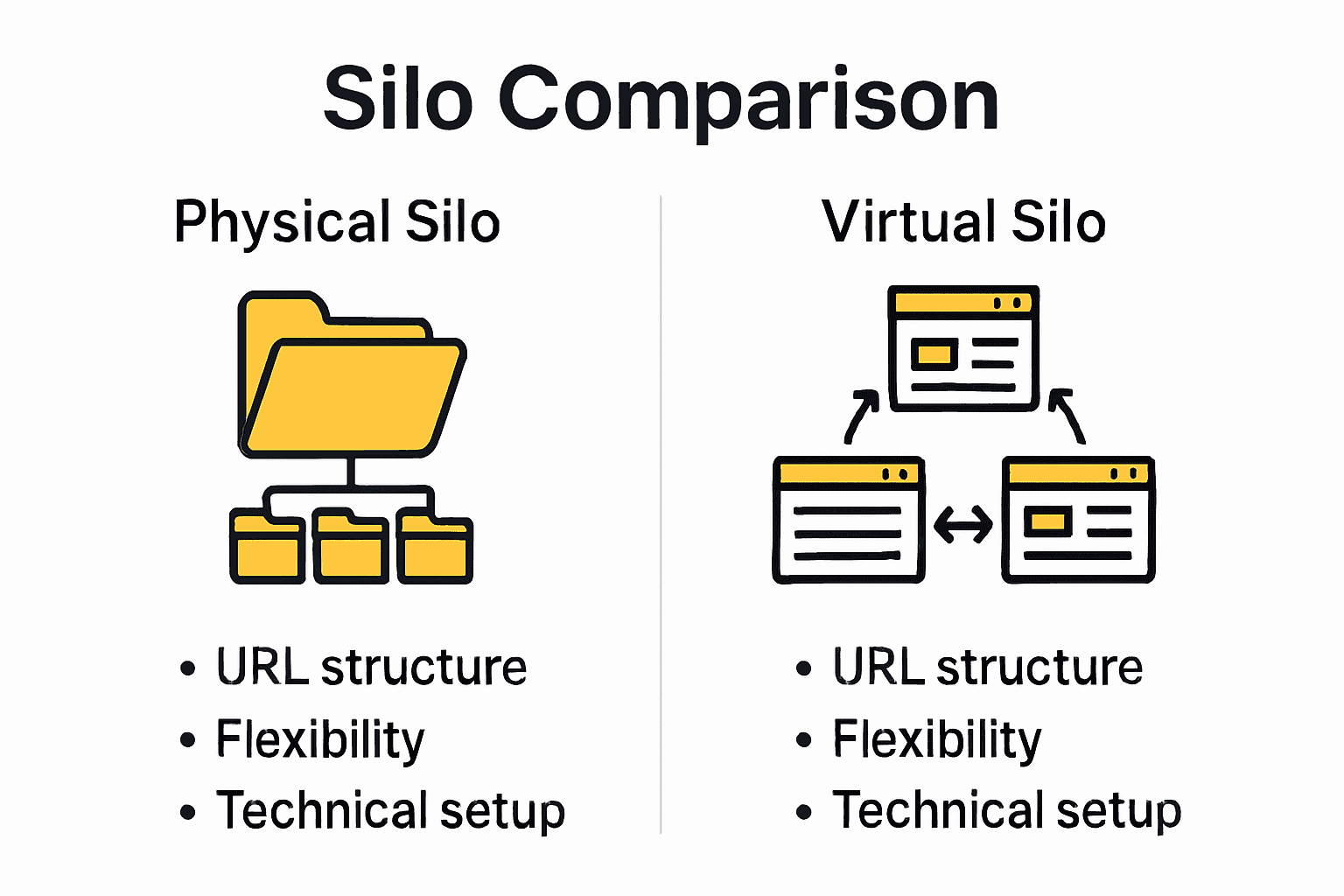
Whether you choose physical or virtual silos depends on your website’s specific needs, content type, and long-term SEO strategy.
 Both approaches aim to improve search engine comprehension, increase topical relevance, and ultimately boost organic search performance.
How SEO Silos Improve Website Rankings
Search engine rankings are dramatically influenced by website architecture, and SEO silos provide a powerful method for boosting online visibility. According to SEO Syrup, implementing a silo structure significantly enhances PageRank flow through strategic internal linking and increases contextual relevance for search engines.
The core mechanism behind silo effectiveness lies in creating clear, thematic content hierarchies. Splinternet Marketing explains that content siloing organizes related information into logical groups, which helps search algorithms better understand and rank website content. By clustering topically related pages, websites signal expertise and depth of knowledge in specific subject areas.
Key ranking improvements from SEO siloing include:
- Enhanced topical authority signals
- More predictable and efficient search engine crawling
- Increased internal link equity distribution
- Improved user navigation and engagement
- Clearer content relevance for target keywords
Websites that successfully implement silo structures essentially create a roadmap for search engines, making it easier for algorithms to comprehend the site’s overall theme and expertise.
This strategic approach transforms complex website content into a well-organized, easily digestible format that both users and search engines appreciate – ultimately driving higher rankings and increased organic traffic.
Key Steps to Implement Effective Silos
Creating an effective silo structure requires a strategic and methodical approach to website content organization. According to SEO Boost, the process begins with comprehensive keyword research to identify core topics and potential subtopics that will form the foundation of your website’s architecture.
SEO Syrup recommends a systematic approach to silo implementation. The key steps involve transforming your keyword research into a structured content strategy. This means developing a main pillar page for each primary topic, then creating supporting pages that dive deeper into specific long-tail keyword variations within that thematic cluster.
The essential steps for implementing an effective silo structure include:
- Conduct comprehensive keyword research
- Identify primary topic clusters
- Create a main pillar page for each cluster
- Develop supporting content pages
- Establish strategic internal linking
- Maintain a clean, hierarchical URL structure
Successful silo implementation is less about rigid rules and more about creating a logical, user-friendly content ecosystem. By carefully organizing your website’s content into thematic, interconnected groups, you signal expertise to search engines and provide clear, navigable pathways for your audience. The goal is to create a website structure that feels intuitive both to search algorithms and human visitors.
Common Mistakes and How to Avoid Them
Navigating the complexities of SEO siloing requires careful planning and strategic execution. According to Search Engine Land, one of the most critical mistakes is creating content silos that inadvertently trap information, making it difficult for users and search engines to discover and navigate through your website.
SEO Syrup highlights several key pitfalls that website owners should be aware of when implementing silo structures. The primary concerns revolve around content contextual relevance, potential information isolation, and overly rigid architectural approaches that don’t adapt to a website’s unique needs.
Common silo implementation mistakes include:
- Creating disconnected content clusters
- Ignoring cross-topic relationships
- Overcomplicating internal linking
- Sacrificing user experience for structure
- Neglecting content quality within silos
The ultimate goal is maintaining a delicate balance between structured content organization and user-friendly navigation. Successful silo strategies recognize that while thematic grouping is important, websites must remain flexible, interconnected, and focused on providing genuine value to visitors. Think of your website as a living ecosystem where content can breathe and interact, rather than a series of locked compartments.
Master SEO Siloing to Transform Your Website Structure and Rankings
Struggling to organize your site content for maximum search engine impact Can SEO siloing feel overwhelming without clear guidance You are not alone Many website owners face challenges linking content strategically while maintaining user-friendly navigation This article reveals how to build strong thematic clusters through physical or virtual silos which empower better crawling and higher rankings But turning this strategy into action requires the right expertise and tools

Take control of your SEO journey today with Words At Scale where you can join our free 7-day advanced keyword research academy Learn to create effective silo structures that boost topical authority and drive organic traffic Fast enrollment means you do not miss out on hands-on training plus access free SEO and blogging tools that simplify building a clear content hierarchy Start now to turn complex website data into an organized, rank-worthy asset and see measurable results in your search performance. Explore all resources at Words At Scale and step confidently into elevated SEO success.
Frequently Asked Questions
What is SEO siloing?
SEO siloing is a website architecture technique that organizes content into distinct, topically-focused groups called silos. This method enhances contextual relevance and helps search engines better understand a website’s core themes.
How does SEO siloing improve website rankings?
SEO siloing improves website rankings by creating clear thematic content hierarchies that enhance topical authority and internal linking. This structure helps search engines crawl the site more effectively, increasing the chances of higher rankings for target keywords.
What are the different types of SEO silos?
There are two main types of SEO silos: physical silos, which involve organizing content into separate directories on the server, and virtual silos, which use internal linking to group related content without changing URL structures.
What common mistakes should be avoided when implementing SEO silos?
Common mistakes include creating disconnected content clusters, ignoring cross-topic relationships, overcomplicating internal linking, sacrificing user experience for structure, and neglecting content quality within silos.