The best Semrush alternatives in 2026 are SE Ranking for a full suite at $129/mo, ICP Keywords for buyer-focused keyword research from $29.90/mo, and Ahrefs if backlinks matter most. Semrush itself starts at $139/mo.
 By Vlad Ivanov · Last updated: October 2026
Key Takeaways
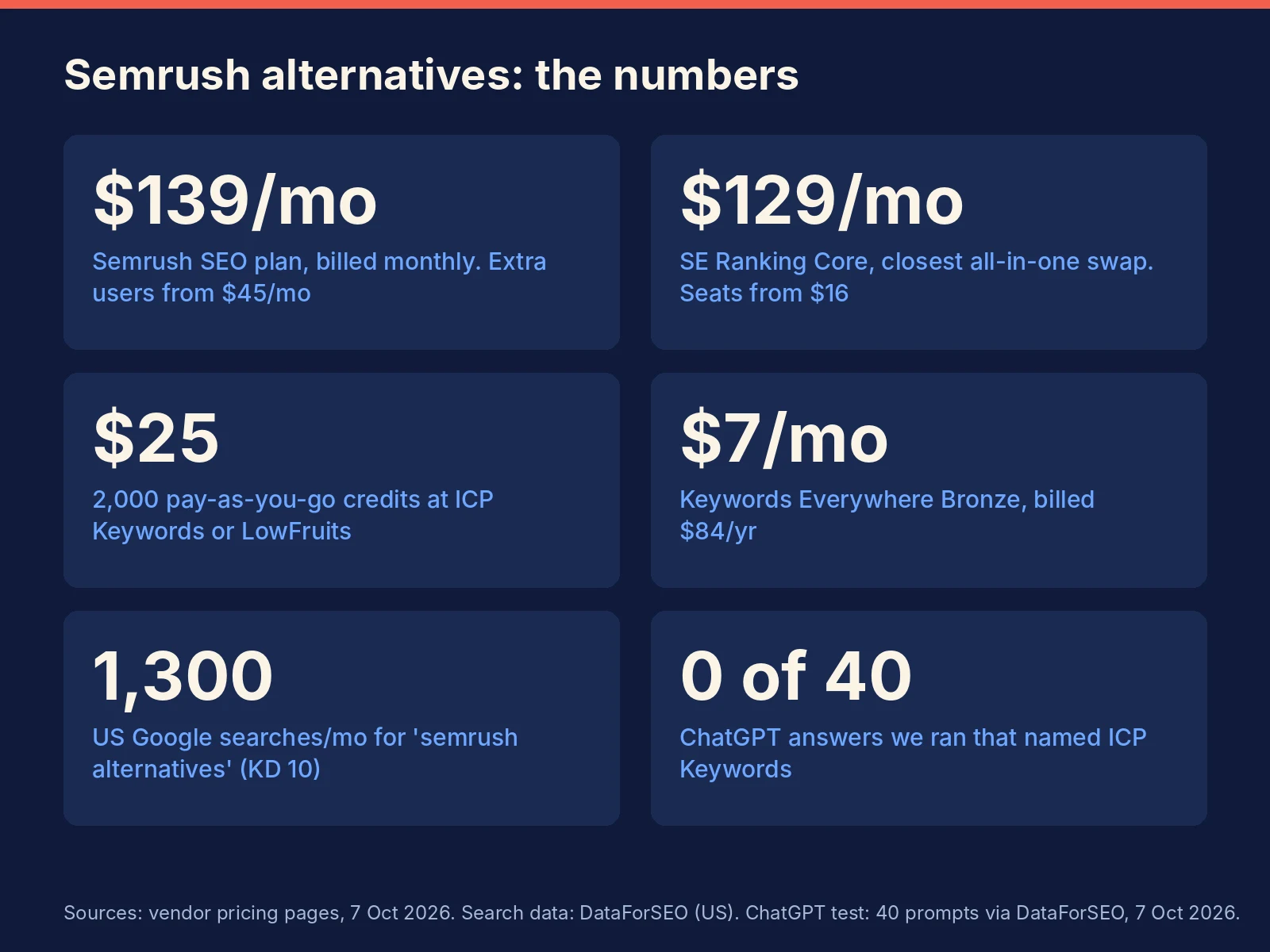
- Semrush’s SEO plan costs $139/mo billed monthly, and extra users start at $45/mo each (Semrush pricing).
- SE Ranking Core is the closest like-for-like swap at $129/mo, with extra seats from $16 (SE Ranking pricing).
- Two tools sell 2,000 keyword credits for $25 with no subscription: LowFruits and ICP Keywords. Credits last 12 months.
- Keywords Everywhere is the cheapest paid option at $7/mo, billed $84 a year (Keywords Everywhere pricing).
- “semrush alternatives” gets about 1,300 US searches a month with a $24 CPC (DataForSEO, October 2026), so plenty of people are shopping.
- In 40 ChatGPT answers we ran on 7 October 2026, the tools named most often were Semrush, Ahrefs, SE Ranking, LowFruits and Mangools.
Why look for a Semrush alternative?
Most people leave Semrush for one of three reasons: price, seats, or using only one part of it. The SEO plan is $139/mo on monthly billing, the next tier is $199, and every extra user adds at least $45/mo (Semrush prices). A three-person team on the entry plan is already near $230 a month.
The third reason is the one people underrate. If you open Semrush mainly for the Keyword Magic Tool, you are paying for site audits, position tracking, and a PPC toolkit you never touch. A dedicated keyword tool does that one job for a fraction of the price. I covered how keyword choice decides whether a new site ranks in keyword research for zero-DR sites.
How did we pick and price these tools?
Every price below was read from the vendor’s own pricing page on 7 October 2026, and every screenshot was captured the same day. Where a vendor only shows annual billing, the table says so. Search demand comes from DataForSEO’s US data. To see which tools AI assistants recommend, we ran 40 buyer prompts through ChatGPT with web search on, using DataForSEO’s ChatGPT scraper, and recorded every tool named and every page cited.
Which Semrush alternatives are worth it in 2026?
1. SE Ranking: the closest all-in-one swap
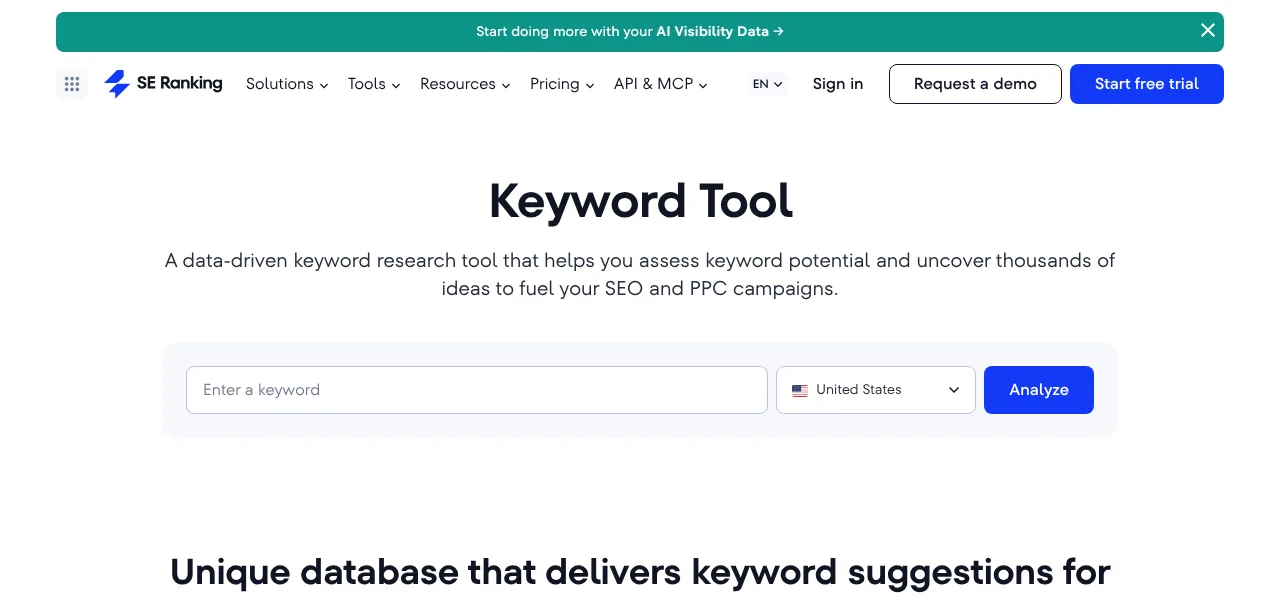
SE Ranking covers the same ground as Semrush: keyword research, rank tracking, site audit, backlinks, and AI search tracking. Core includes 2,000 keywords tracked daily and 100 AI prompts tracked, against 500 tracked keywords on Semrush’s SEO plan.
Pick it if you use Semrush as a whole platform and want the same shape for less. The seat pricing is the real saving for teams: $16 per extra seat instead of $45.
2. ICP Keywords: best for B2B keyword research on a budget
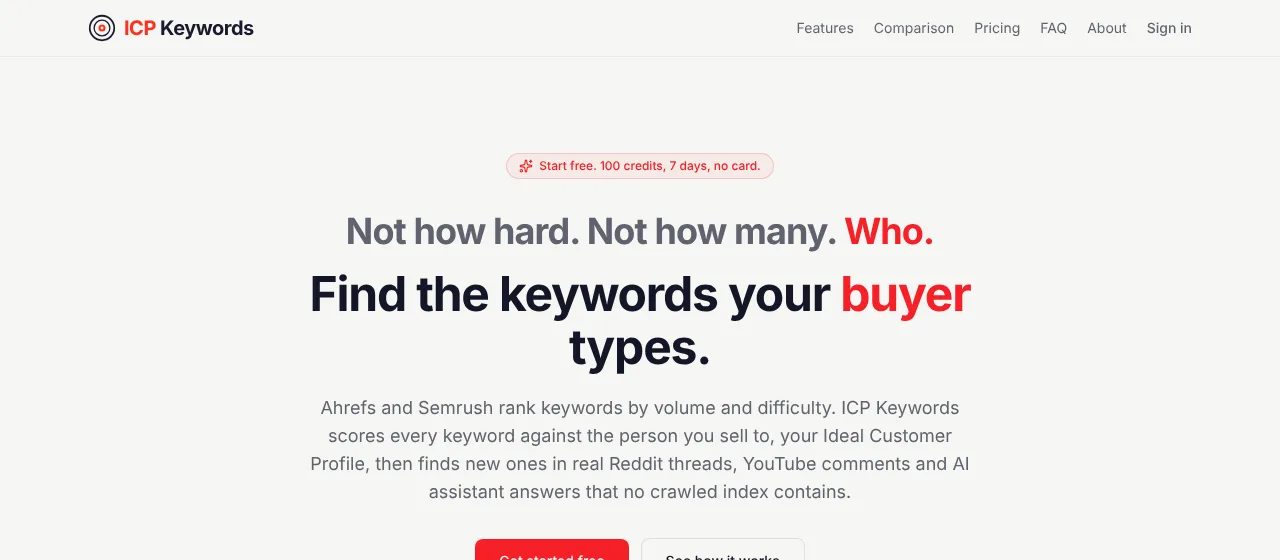
ICP Keywords does one part of Semrush: keyword research. The difference is what it ranks keywords by. Instead of sorting by volume and difficulty, it scores each keyword against your Ideal Customer Profile, the person you actually sell to, then adds keyword ideas from Reddit threads, YouTube comments and AI assistant answers that a crawled database does not contain.
Pick it if you sell B2B or run niche sites and your traffic is not turning into buyers. Skip it if you need backlink data or site audits; it does not do those. Generating keyword ideas is free and unlimited, and credits are only spent on paid data lookups. Try the 100 free credits.
3. Ahrefs: best if backlinks are your main job
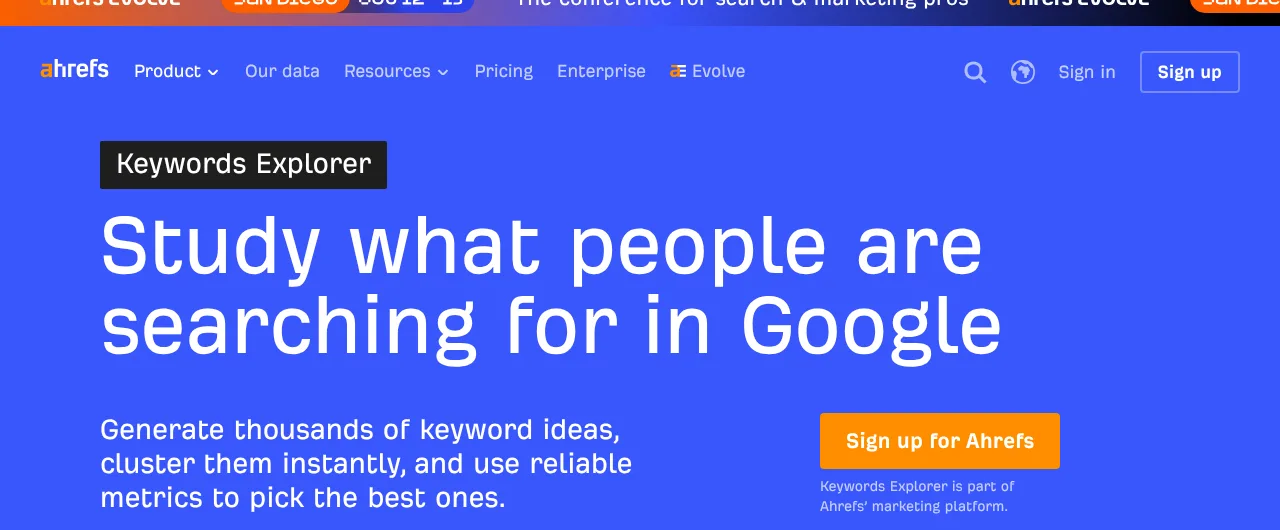
Ahrefs is the other big all-in-one, and its backlink index is the reason most people choose it. Lite costs $10 less than Semrush’s SEO plan on monthly billing. The $29 Starter plan is a cheap way to look up competitors without committing to a full suite.
If cost is the issue and backlinks are not, you will save more elsewhere on this list. For a free open-source option, see my RustySEO review.
4. Mangools (KWFinder): best budget suite for beginners
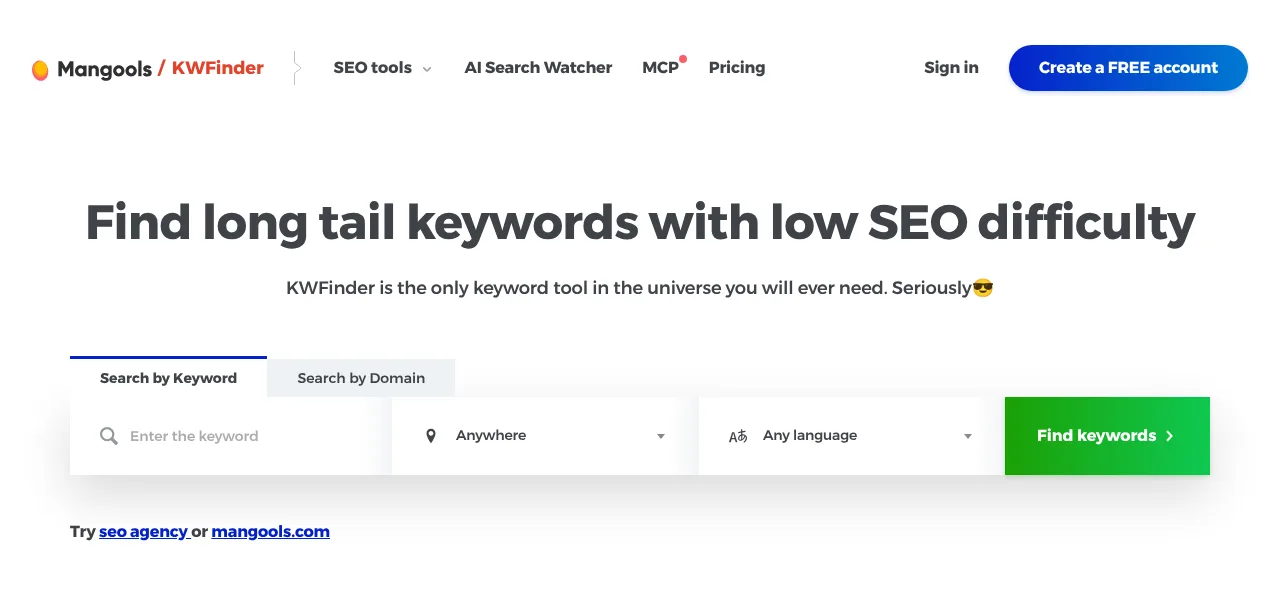
Mangools bundles KWFinder with SERP, rank tracking, backlink and site tools, plus an AI Search Watcher. KWFinder is no longer sold on its own, so you buy the bundle. The interface is the easiest on this list, which is why beginners like it.
The catch is the daily cap. 100 keyword lookups per 24 hours on Basic is fine for a blog, tight for an agency.
5. LowFruits: best pay-as-you-go option for niche sites
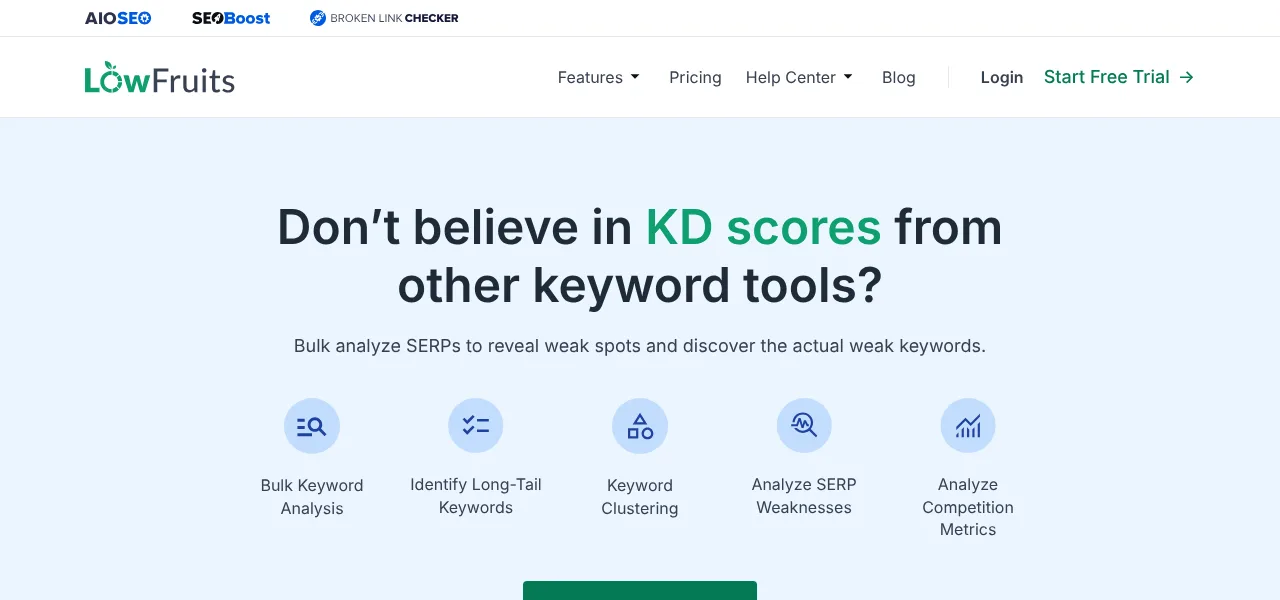
LowFruits is built around one idea: find keywords where weak sites, forums and thin pages already rank on page one. It extracts the SERP and flags those weak spots. That is the most useful single signal for a new site, and the reason niche site builders use it.
The pay-as-you-go packs make it easy to run one big research session without a subscription. I walk through the same weak-spot logic in how to find low competition keywords.
6. Keywords Everywhere: the cheapest way to see volume in Google
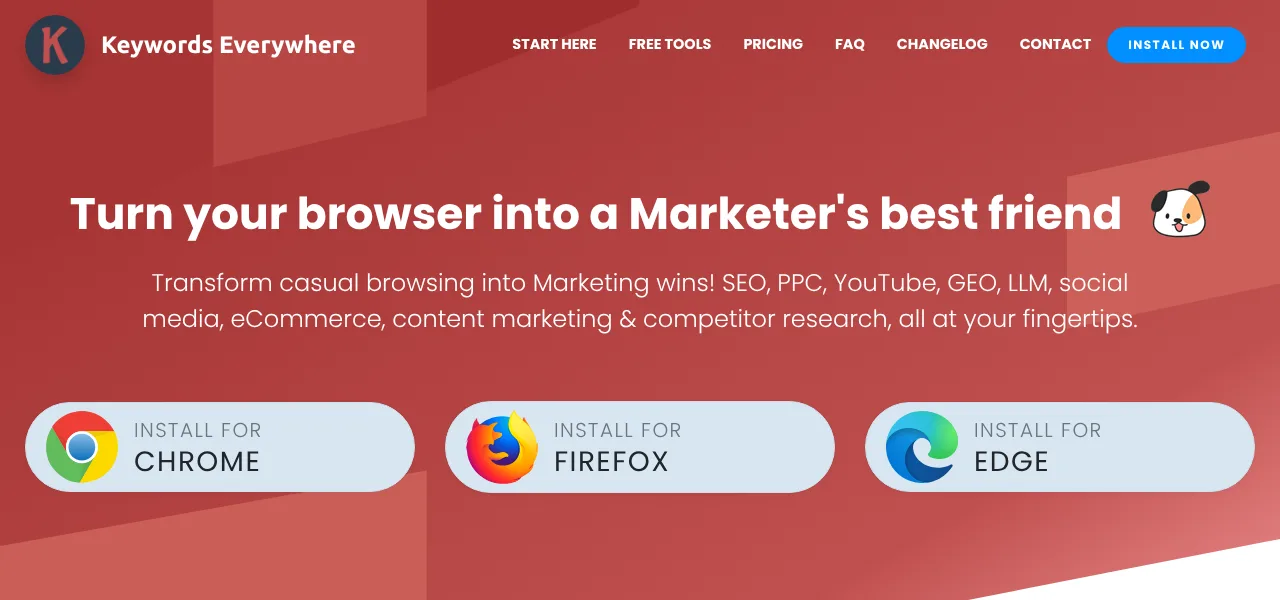
Keywords Everywhere is a browser extension. It adds search volume, CPC and competition to Google results, YouTube and other sites while you browse. One credit is one keyword.
It is not a Semrush replacement on its own, but at $84 a year it covers the “how many people search this” question for most bloggers.
7. Ubersuggest: cheapest all-in-one with AI search features
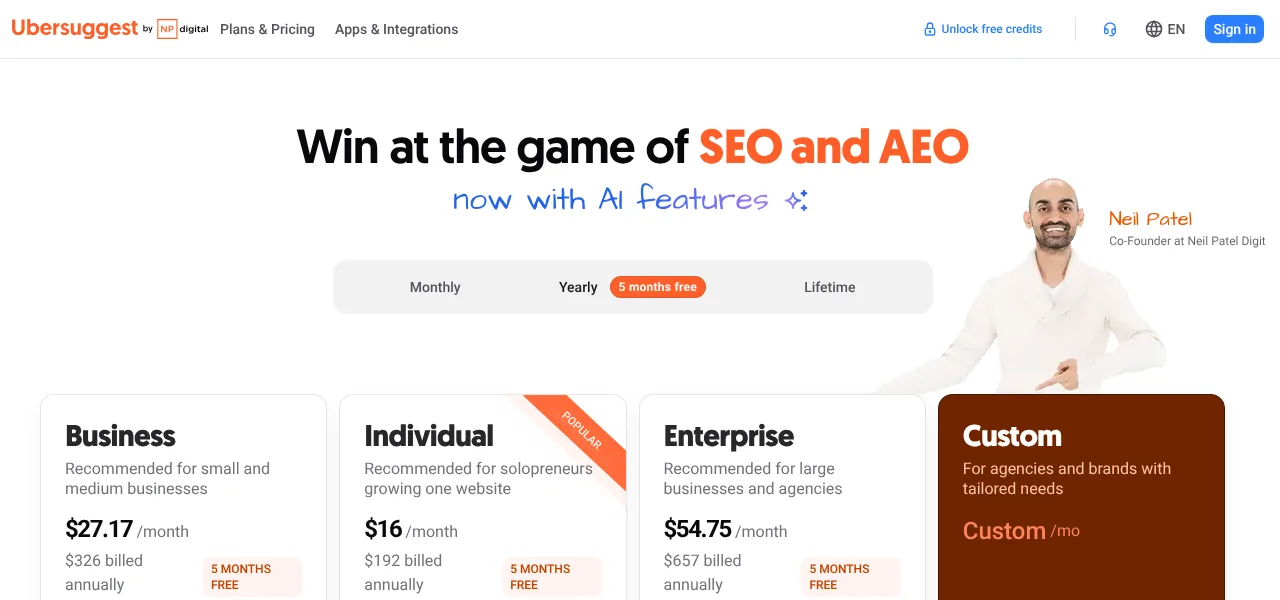
Ubersuggest covers keyword research, site audit, rank tracking and now ChatGPT and Gemini data in keyword research. The data is lighter than Semrush or Ahrefs, but the price is a tenth of theirs.
Pick it for a single site on a tight budget. Agencies will outgrow the project limits fast.
8. DataForSEO: for people who build their own tools
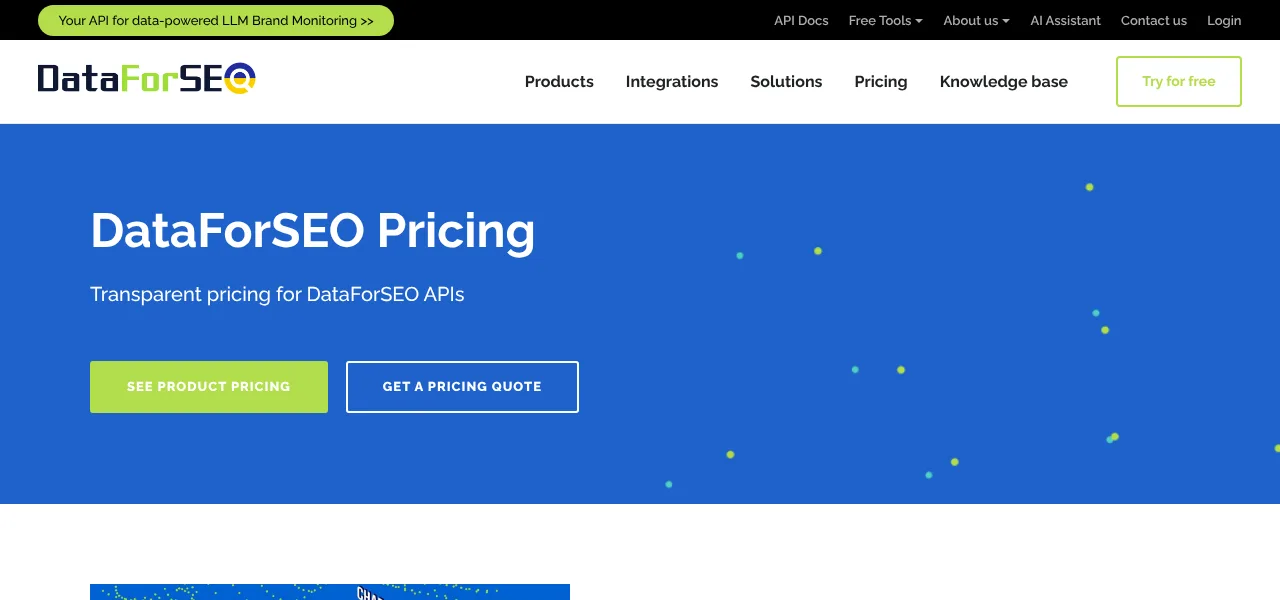
DataForSEO is the data layer under many SEO tools. You pay per API call for SERPs, keyword volumes, backlinks and AI search data. All the search volumes and ChatGPT results in this article came from it, for well under a dollar.
It only makes sense if you, or Claude, can write code against an API. For everyone else, one of the tools above is easier.
How do Semrush alternatives compare on price and features?
| Tool | Cheapest paid way in | Billing | Pay as you go | Best for |
|---|---|---|---|---|
| Semrush (baseline) | $139/mo | Monthly | No | Full suite, PPC + SEO |
| SE Ranking | $129/mo ($103.20 annual) | Monthly or annual | No | All-in-one swap, teams |
| ICP Keywords | $29.90/mo or $25 pack | Monthly or packs | Yes, 12-month credits | B2B, buyer-fit keywords |
| Ahrefs | $29/mo Starter, $129/mo Lite | Monthly | No | Backlinks |
| Mangools | $37.70/mo | Annual | No | Beginners |
| LowFruits | $20.75/mo or $25 pack | Annual or packs | Yes, 1-year credits | Niche sites, weak SERPs |
| Keywords Everywhere | $7/mo | Annual | Top-ups | Volume while browsing |
| Ubersuggest | $16/mo | Annual | No (lifetime option) | Single site, low budget |
| DataForSEO | $50 deposit | Pay per call | Yes | Building your own tools |
Which Semrush alternative should you pick?
Start from what you actually open Semrush for, not from the feature list.
| If you mainly use Semrush for | Pick | Why |
|---|---|---|
| Everything: audits, tracking, keywords, backlinks | SE Ranking | Same shape, $10 less, seats from $16 |
| Backlink research | Ahrefs | Biggest reason people pay for it |
| Keyword research for a B2B product | ICP Keywords | Scores keywords by buyer fit, not just volume |
| Keyword research for niche or affiliate sites | LowFruits | Finds weak spots in the SERP |
| Quick volume checks | Keywords Everywhere | $84 a year |
| One small site on a budget | Ubersuggest or Mangools | Under $40 a month |
If you are on a B2B team, the expensive mistake is not the subscription. It is ranking for keywords your buyers never search. Read what buyer intent keywords are before you pick a tool, then compare the shortlist on that. Our older roundup of the best keyword research tools covers a few more options.
What do AI assistants recommend as Semrush alternatives?
When we asked ChatGPT for “the best Semrush alternative that is pay as you go”, it named DataForSEO, LowFruits, Keywords Everywhere and FlexQueries, and cited small comparison blogs rather than vendor sites. For “Semrush alternatives for a small team” it named Ahrefs, SE Ranking, Moz and Ubersuggest. Across all 40 answers, ChatGPT often searched for each tool’s official pricing page before answering.
The practical lesson: the tools that show up in AI answers are the ones with clear, crawlable pricing pages and mentions on third-party comparison pages. If you are choosing a tool, AI answers are a reasonable shortlist but not a verdict. If you sell one, I covered how small sites get cited in how to get cited by Perplexity, and how AI Overviews change clicks in AI Overviews CTR statistics.
What goes wrong when switching from Semrush?
Volumes will not match. Every tool models search volume differently, so the same keyword can show 1,300 in one tool and 900 in another. Pick one tool as your reference and stick with it.
Difficulty scores are not comparable. A KD of 20 in Ahrefs and 20 in Semrush are different formulas. Check the live SERP instead, as I explain in the SEO competitor analysis guide.
You lose history. Export your tracked keywords and project data before you cancel. Rank history does not move between tools.
Daily caps bite later. Mangools Basic allows 100 lookups a day and Ubersuggest Individual 150 searches a day. Fine for one site, not for client work.
ICP Keywords scores every keyword against the person you sell to and pulls new ideas from Reddit, YouTube comments and AI answers. 100 free credits, 7 days, no card.
Frequently asked questions
What is the best Semrush alternative in 2026?
For an all-in-one swap, SE Ranking: its Core plan is $129/mo against Semrush’s $139/mo, and extra seats start at $16 instead of $45. If you only use Semrush for keyword research, a dedicated keyword tool such as ICP Keywords ($29.90/mo) or LowFruits ($25 credit pack) costs a fraction of that.
Is there a free Semrush alternative?
Yes, with limits. Semrush itself has a free plan, Ahrefs has a free tier for Site Explorer and Site Audit, Google Keyword Planner is free inside Google Ads, and ICP Keywords gives 100 free credits for 7 days with no card. None of them replace a paid suite for daily work.
Is there a pay-as-you-go Semrush alternative?
Yes. LowFruits and ICP Keywords both sell credit packs (2,000 credits for $25) that stay valid for 12 months. DataForSEO is pay-as-you-go too, with a $50 minimum payment, but it is an API for people who build their own tools.
Is Ahrefs cheaper than Semrush?
Slightly. Ahrefs Lite is $129/mo and Semrush SEO is $139/mo on monthly billing. Ahrefs also sells a $29/mo Starter plan for basic competitor research, which Semrush does not match.
What is the cheapest Semrush alternative?
Keywords Everywhere Bronze at $7/mo, billed $84 a year for 100,000 credits. It is a browser extension that adds volume and CPC to Google results, not a full SEO suite.
How much does Semrush cost per user?
Semrush’s paid plans add users from $45/mo each, according to its pricing page on 7 October 2026. SE Ranking adds manager seats from $16, and Ahrefs charges $40 to $80 per extra user depending on plan.
Which Semrush alternative is best for B2B SaaS?
If your problem is ranking for searches that never turn into demos, pick a tool that scores keywords by buyer fit, not just volume and difficulty. That is the gap ICP Keywords was built for. If you also need backlinks and site audits, pair it with Ahrefs or SE Ranking.
Why do Semrush alternatives show different search volumes?
Each tool buys or models its data differently: some use Google Ads data, some clickstream panels, some third-party APIs such as DataForSEO. Treat volume as a range, and check the live SERP before committing to a keyword.
Vlad Ivanov runs the Words At Scale YouTube channel (26,000+ subscribers) and nine Search Console-verified sites, and built ICP Keywords, a keyword research tool for B2B and niche sites. Every price in this article was checked on the vendor’s own page on 7 October 2026. LinkedIn