
More than 50 percent of american businesses face hidden website issues that stall their growth even before they start climbing the search results. Search engine optimization is more than guesswork or luck. It involves a deep dive into what works and what holds your site back. If you want stronger results and fewer wasted efforts, understanding SEO audits gives you the insight needed to make measurable progress.
Table of Contents
- Defining SEO Audits And Core Concepts
- Types Of SEO Audits And Their Purposes
- Step-By-Step SEO Audit Process Explained
- Common SEO Audit Issues And Solutions
- Best Practices And Mistakes To Avoid
Key Takeaways
| Point | Details |
|---|---|
| Understanding SEO Audits | SEO audits evaluate a website’s search engine performance to identify improvement opportunities and obstacles to organic visibility. |
| Types of SEO Audits | Different SEO audits, such as technical, content, and competitive, target specific aspects for optimized strategies. |
| Audit Process Steps | A systematic audit process involves analyzing technical infrastructure, on-page elements, and comprehensive performance reviews. |
| Avoiding Common Mistakes | Regular audits should avoid pitfalls like ignoring mobile responsiveness and over-optimization, focusing instead on data-driven solutions. |
Defining SEO Audits and Core Concepts
An SEO audit is a comprehensive evaluation of a website’s search engine performance, designed to identify opportunities for improvement and uncover potential obstacles preventing optimal organic visibility. According to Wikipedia, a website audit provides an “overview of the site’s structure, performance, traffic patterns, and the effectiveness of individual pages,” with the primary goal of revealing technical and strategic weaknesses that might impede web performance.
Search engine optimization (SEO) is fundamentally about improving website visibility through strategic optimization techniques. As defined by Wikipedia, SEO focuses on enhancing “the quality and quantity of website traffic” specifically from organic search results. This means attracting more visitors through unpaid search mechanisms rather than relying on paid advertising or direct traffic sources.
Core components of an effective SEO audit typically include:
- Technical website infrastructure analysis
- Content quality and relevance assessment
- Keyword performance evaluation
- Backlink profile examination
- Site speed and mobile responsiveness testing
Successful SEO audits provide actionable insights that help website owners understand their current digital performance and create targeted strategies for improvement. By systematically analyzing each aspect of a website’s search engine optimization, businesses can develop precise roadmaps to enhance their online visibility and attract more qualified organic traffic.
For a deeper understanding of conducting comprehensive SEO audits, check out our complete guide to the role of SEO audits.
Types of SEO Audits and Their Purposes
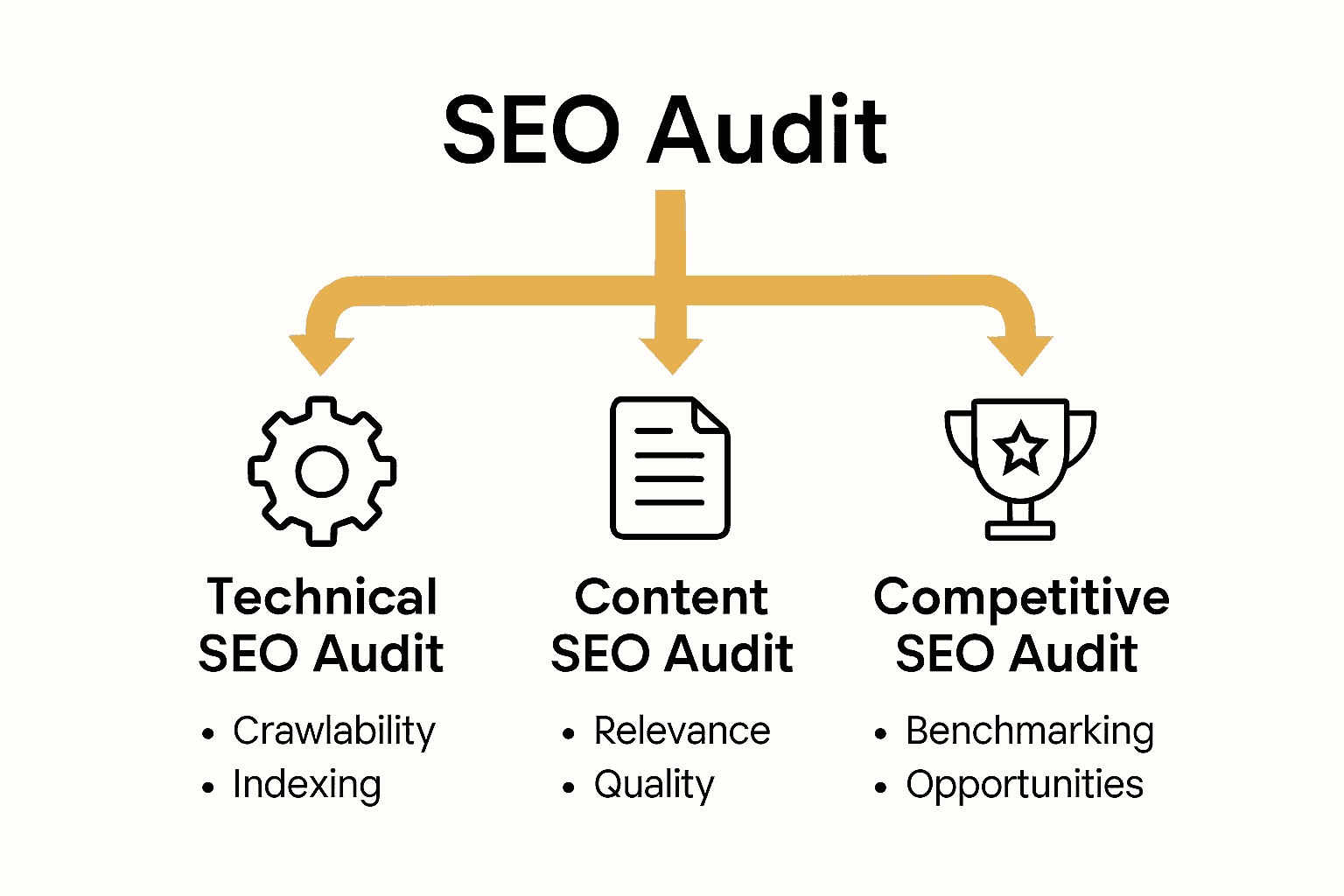
SEO audits are not one-size-fits-all strategies, but rather specialized assessments targeting different aspects of a website’s digital performance. Understanding the various types of SEO audits helps businesses develop targeted optimization strategies that address specific challenges and opportunities.
Technical SEO Audits focus on the backend infrastructure and performance elements that impact search engine crawling and indexing. These comprehensive evaluations examine critical factors such as:
- Website loading speed
- Mobile responsiveness
- Site architecture
- Crawlability and indexing potential
- Security protocols (HTTPS)
- Structured data implementation
Content SEO Audits dive deep into the qualitative and quantitative aspects of a website’s content strategy. These assessments analyze:
- Keyword relevance and optimization
- Content depth and comprehensiveness
- Readability and user engagement
- Content gaps and opportunities
- Internal linking structures
- Alignment with search intent
Competitive SEO Audits provide strategic insights by benchmarking a website against industry competitors. By examining competitor performance, businesses can identify:
- Keyword ranking opportunities
- Content strategy gaps
- Backlink acquisition potential
- Strategic positioning in search results
While each audit type serves a unique purpose, they collectively provide a holistic view of a website’s search engine optimization potential.
 For a comprehensive understanding of leveraging these audit strategies, explore our guide on why SEO tools matter.
Step-by-Step SEO Audit Process Explained
Conducting a comprehensive SEO audit requires a systematic approach that methodically evaluates multiple aspects of a website’s digital performance. According to Alooba, an effective SEO audit covers key areas including technical SEO, on-page SEO, and off-page SEO, each demanding careful analysis and strategic optimization.
Step 1: Technical Infrastructure Analysis
Begin by examining the technical foundation of your website. This critical phase involves:
- Assessing website loading speed
- Verifying mobile responsiveness
- Checking URL structure
- Reviewing XML sitemap configuration
- Analyzing robots.txt file settings
- Ensuring secure HTTPS implementation
Step 2: On-Page SEO Evaluation
Delve into the content and structural elements that directly impact search engine rankings:
- Analyze keyword usage and optimization
- Review meta tag effectiveness
- Assess content quality and relevance
- Examine header tag hierarchy
- Evaluate internal linking strategies
- Check content alignment with search intent
Step 3: Comprehensive Performance Review
The final stage involves synthesizing insights from technical and content assessments to develop a holistic optimization strategy. This includes identifying performance gaps, prioritizing improvements, and creating an actionable roadmap for enhanced search engine visibility.

For a deeper technical dive into site optimization techniques, check out our technical SEO step-by-step guide.
Common SEO Audit Issues and Solutions
Navigating the complex landscape of search engine optimization requires identifying and addressing common challenges that can hinder website performance. According to Alooba, effective SEO audits systematically examine key areas including technical SEO, on-page optimization, and content strategies to uncover potential roadblocks.
Technical Performance Issues
Common technical challenges that can derail search engine rankings include:
- Slow website loading speeds
- Poor mobile responsiveness
- Inefficient URL structures
- Misconfigured XML sitemaps
- Restrictive robots.txt settings
- Inadequate HTTPS security implementation
Content and Optimization Challenges
Keyword and content-related problems frequently emerge during comprehensive SEO audits:
- Keyword cannibalization
- Thin or duplicate content
- Ineffective meta tag optimization
- Poor header tag hierarchy
- Weak internal linking strategies
- Misalignment with user search intent
Strategic Solutions and Remediation
Addressing SEO issues requires a proactive, methodical approach. Successful mitigation involves conducting thorough diagnostics, prioritizing critical improvements, and implementing targeted optimizations that align with search engine best practices.
For practical insights into addressing technical SEO challenges, explore our technical SEO checklist to boost search rankings.
Best Practices and Mistakes to Avoid
Successful SEO audits require a strategic approach that balances technical precision with comprehensive analysis. According to Alooba, effective SEO strategies encompass multiple domains including technical SEO, on-page optimization, and content development, each demanding meticulous attention and strategic implementation.
Best Practices for SEO Auditing
Critical strategies to maximize audit effectiveness include:
- Conduct regular comprehensive audits
- Use multiple diagnostic tools
- Prioritize data-driven insights
- Develop holistic optimization strategies
- Create actionable improvement roadmaps
- Maintain continuous performance monitoring
Common Mistakes to Avoid
Potential pitfalls that can undermine SEO audit effectiveness:
- Overlooking mobile responsiveness
- Neglecting page loading speed
- Ignoring technical infrastructure issues
- Keyword stuffing and over-optimization
- Duplicate or thin content creation
- Inconsistent internal linking strategies
Strategic Optimization Approach
Successful SEO practitioners understand that audits are not one-time events but ongoing processes. Continuous learning, adaptive strategies, and proactive performance management separate exceptional digital marketing efforts from mediocre implementations.
For practical examples of effective SEO tactics, explore our examples of SEO tactics for website growth.
Unlock Your Website’s True Potential with Expert SEO Tools and Training
Facing challenges like slow site speed, poor mobile responsiveness, or keyword optimization confusion can stall your journey to top search rankings. This guide’s focus on technical infrastructure, content quality, and strategic SEO audits highlights exactly what you need to fix. Imagine having clear insights and practical solutions at your fingertips to overcome these obstacles and boost your organic traffic dramatically.

Explore our Tools – WordsAtScale to access free SEO and blogging resources designed for every skill level. Pair these with expert copywriting strategies from our Copywriting – WordsAtScale category to create content that ranks and resonates. Don’t wait until poor site performance costs you more traffic. Visit WordsAtScale now and secure your spot in the free 7-day advanced keyword research academy. Take control of your SEO success today.
Frequently Asked Questions
What is an SEO audit?
An SEO audit is a comprehensive evaluation of a website’s search engine performance designed to identify opportunities for improvement and uncover obstacles that hinder organic visibility.
Why is conducting an SEO audit important?
Conducting an SEO audit is crucial for discovering technical and strategic weaknesses that may limit a website’s effectiveness, leading to improved search engine rankings and increased organic traffic.
What are the main types of SEO audits?
The main types of SEO audits include Technical SEO Audits, Content SEO Audits, and Competitive SEO Audits, each focusing on different aspects of a website’s performance.
How can I start the SEO audit process?
Start the SEO audit process by analyzing the technical infrastructure of your website, evaluating on-page SEO elements, and conducting a performance review to identify and prioritize optimization strategies.