AI Overviews CTR Statistics 2026: Every Published Number on Clicks, Zero-Click & Citation Lift
Key Takeaways
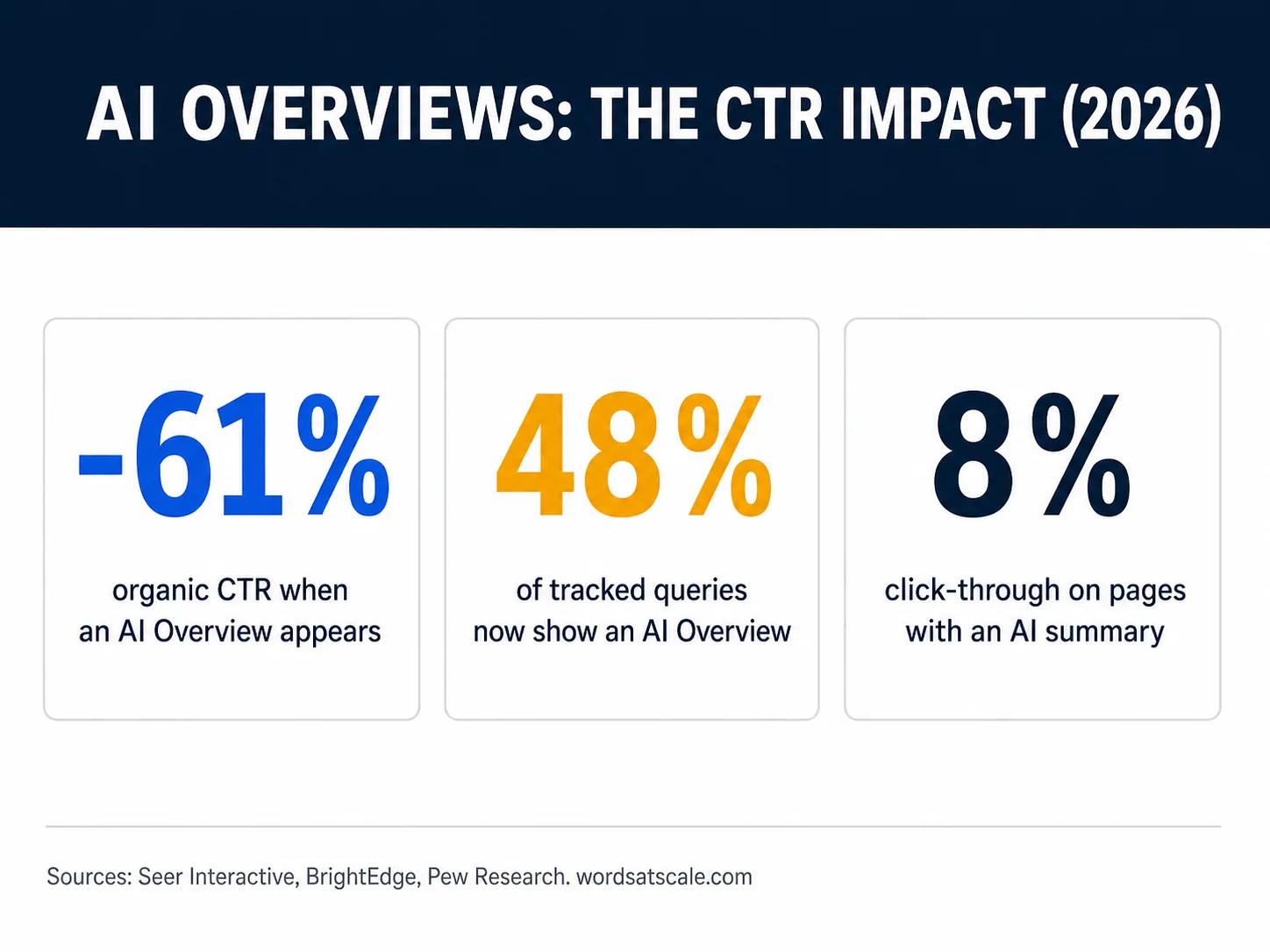
- → Organic CTR dropped 61% (1.76% → 0.61%) and paid CTR dropped 68% on queries showing an AI Overview (Seer Interactive, Sept 2025)
- → AI Overviews appeared on ~48% of tracked queries in Feb 2026, up from ~31% a year earlier — a 58% YoY jump (BrightEdge)
- → AIO-query organic CTR is recovering: from a 1.3% floor in Dec 2025 to 2.4% in Feb 2026, up 85% in two months (Seer Interactive, 2026)
- → Brands cited inside an AI Overview earn roughly +120% more organic clicks per impression than uncited brands (Seer Interactive, 2026)
- → On pages with an AI summary, only ~8% of visits ended in a click, versus ~15% without one (Pew Research, 2025)
- → Coverage estimates span 15.7%–60.3% of queries depending on dataset and methodology (Semrush / Conductor / Xponent21)
- → Google still sends 87.6% of all search referral traffic; every AI engine combined sends ~0.29% (Cloudflare Radar, May 2026)
AI Overviews are the biggest change to the Google search results page in a decade, and the click-through-rate (CTR) data tells the story plainly: when Google answers the question itself, fewer people click. This page collects every published 2026 number worth citing — the CTR drop, how often AI Overviews appear, the early 2026 recovery, zero-click rates, and the one metric that still moves traffic. Each figure is attributed to its primary source, and where studies disagree, both numbers are shown. If you are still treating AI Overviews as a side issue, the growing role of AI in SEO makes a strong case that they now belong at the center of your strategy.
1 How Far Did CTR Actually Fall?
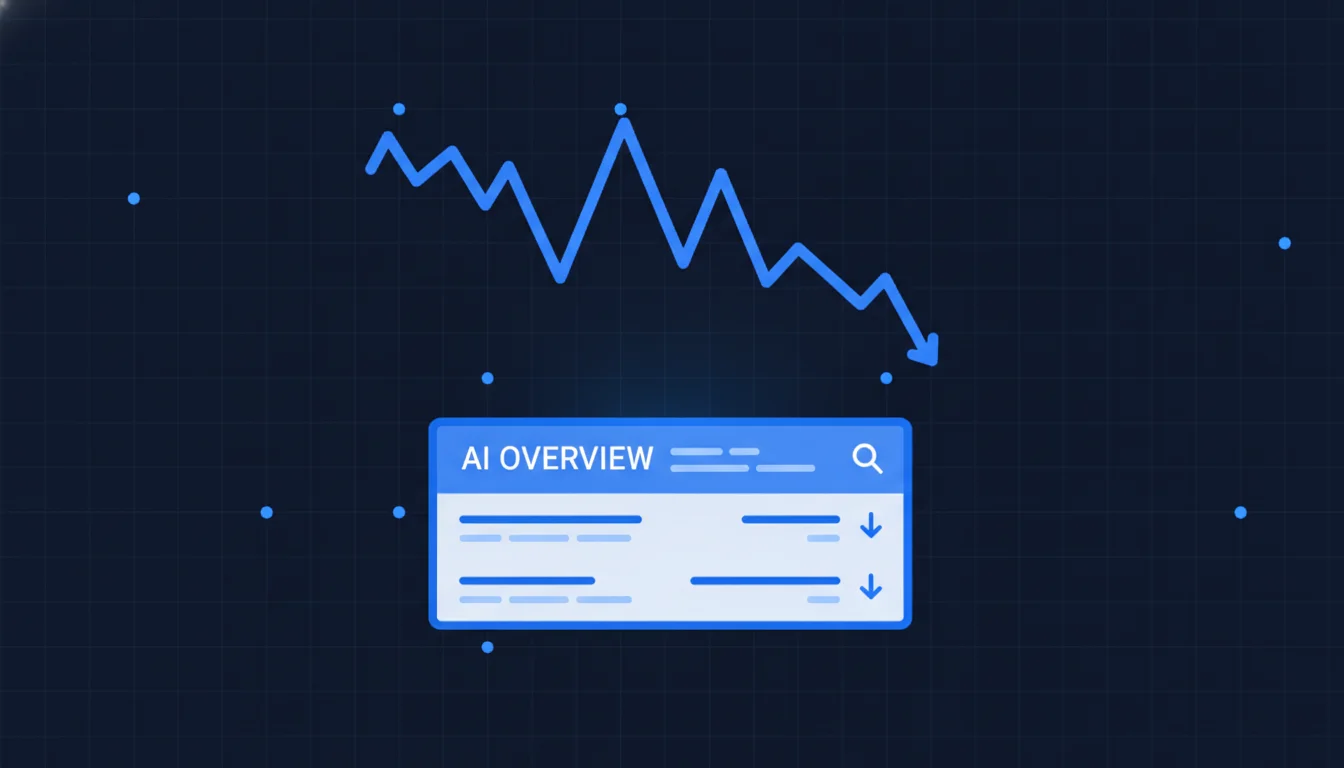
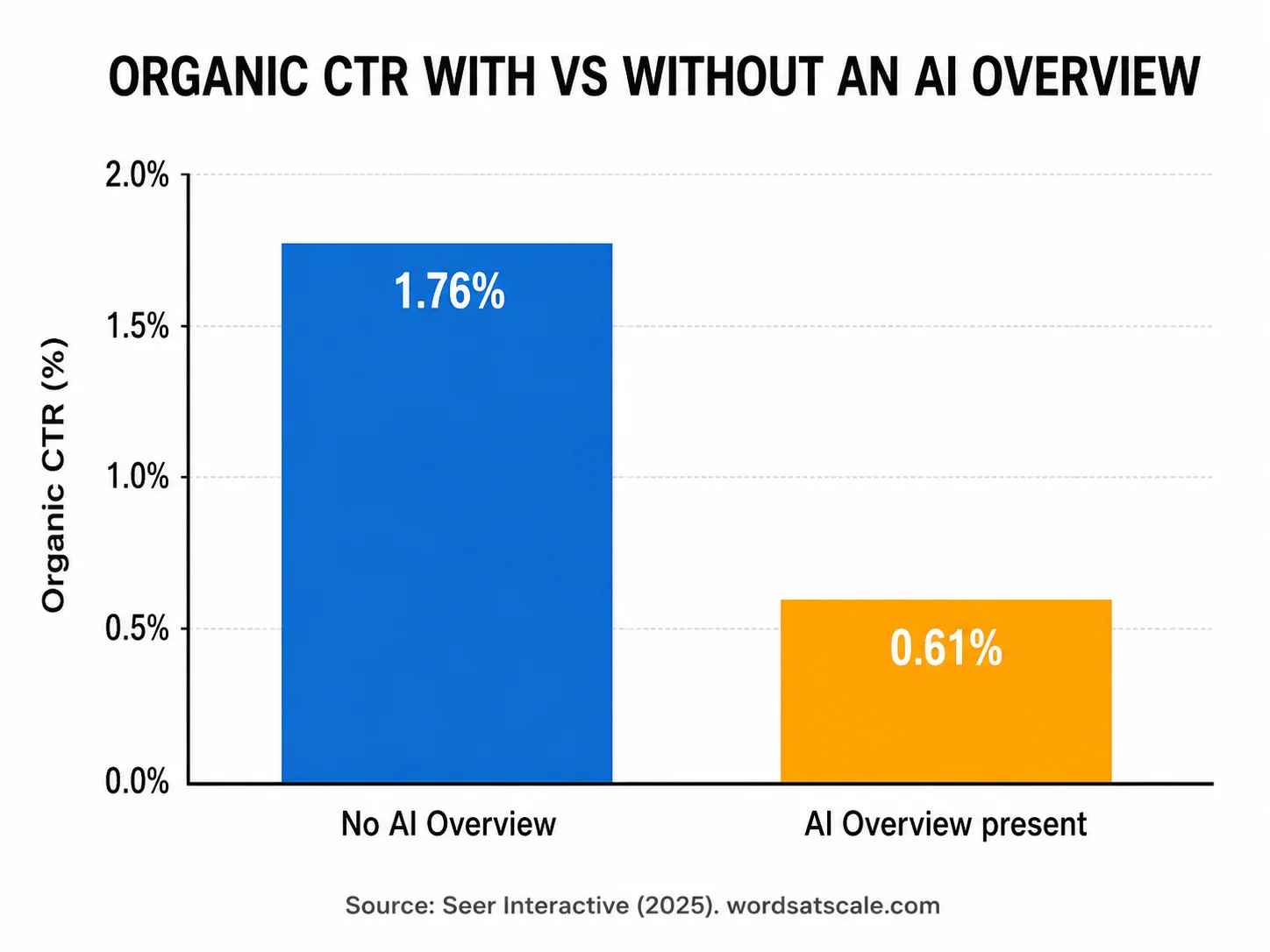
On queries where an AI Overview appears, Seer Interactive measured organic CTR falling 61% — from 1.76% to 0.61% — and paid CTR falling 68%, from 19.7% to 6.34%, across 3,119 informational queries.
The headline number that reset the industry’s expectations came from Seer Interactive’s September 2025 analysis. The drop is sharpest on the informational queries that make up the bulk of most content sites’ traffic, because those are exactly the questions an AI Overview is built to answer in place.
| Metric | Value | Source |
|---|---|---|
| Organic CTR without AI Overview | 1.76% | Seer Interactive (Sept 2025) |
| Organic CTR with AI Overview present | 0.61% | Seer Interactive (Sept 2025) |
| Organic CTR change | −61% | Seer Interactive (Sept 2025) |
| Paid CTR without AI Overview | 19.7% | Seer Interactive (Sept 2025) |
| Paid CTR with AI Overview present | 6.34% | Seer Interactive (Sept 2025) |
| Paid CTR change | −68% | Seer Interactive (Sept 2025) |
| Source: Seer Interactive AIO Impact Study, September 2025 | ||
The paid-search collapse matters as much as the organic one: a 68% CTR drop means advertisers pay for impressions on AIO queries that convert to far fewer clicks. For anyone weighing where to spend, this is a sharp reminder of why tracking the right SEO metrics matters rather than reporting raw rankings that no longer map to traffic.
2 How Often Do AI Overviews Even Appear?
It depends entirely on who is measuring. BrightEdge put AI Overview presence at ~48% of tracked queries in February 2026, while Semrush’s 10-million-keyword panel saw just 15.7% in late 2025, and Xponent21 measured 60.3% in the US by April 2026.
This is the most misquoted statistic in the niche, so it is worth showing the spread in full. The differences come from sample composition: panels weighted toward informational, long-tail terms show far higher AIO presence than broad commercial keyword sets. Treat any single coverage figure with suspicion, and always cite the dataset.
| Measurement | AIO Coverage | Source |
|---|---|---|
| Presence, Feb 2025 | ~31% | BrightEdge |
| Presence, Feb 2026 | ~48% | BrightEdge |
| Peak, July 2025 | ~24.6% | Semrush (10M kw) |
| Presence, Nov 2025 | ~15.7% | Semrush (10M kw) |
| Benchmark, Q1 2026 | ~25.1% | Conductor (21.9M queries) |
| US prevalence, Apr 2026 | ~60.3% | Xponent21 |
| Sources: BrightEdge 9-industry tracker; Semrush 10M-keyword study; Conductor Q1 2026; Xponent21 April 2026 | ||
Coverage is also wildly uneven by sector. Healthcare queries trigger an AI Overview 88% of the time, education 83%, and B2B technology 82% — while entertainment sits near 37%. If you operate in a high-coverage vertical, AIO optimisation is not optional. Matching content to that intent is the same discipline behind semantic SEO: answer the entity, not just the keyword.
3 Is the CTR Damage Recovering in 2026?
Yes, partially. Seer Interactive’s 2026 update found AIO-query organic CTR rebounded from a 1.3% floor in December 2025 to 2.4% in February 2026 — an 85% rise in two months — though still far below pre-AIO baselines.
The recovery is the most under-reported part of the story. As Google added more and better-placed links inside AI Overviews and AI Mode, some clicks returned. The data covers roughly 53 brands and 5.47 million tracked queries, so it is a meaningful signal rather than a blip — but a 2.4% CTR is still a long way from the 1.76% baseline organic CTR that pre-AIO informational queries enjoyed.
| Metric | Value | Source |
|---|---|---|
| AIO-query organic CTR floor, Dec 2025 | 1.3% | Seer Interactive (2026) |
| AIO-query organic CTR, Feb 2026 | 2.4% | Seer Interactive (2026) |
| Two-month change | +85% | Seer Interactive (2026) |
| Source: Search Engine Land / Seer Interactive recovery study, 2026 | ||
The lesson for content owners is to plan for a structurally lower informational CTR and to capture demand higher in the funnel. That shifts value toward buyer-intent keywords and toward formats Google is less likely to fully summarise, like tools, calculators and original data.
4 The Zero-Click Reality
Pew Research found that on pages where an AI summary appeared, only about 8% of visits resulted in a click to any source — roughly half the ~15% click rate on pages without one. Industry estimates put total zero-click search between 43% and 60%.
Zero-click is not new, but AI Overviews accelerate it. The Pew study monitored real browsing behaviour rather than modelled CTR curves, which makes its near-halving of click rates one of the more credible data points in the set. The practical effect: a larger share of your impressions now produce no visit at all, which is why measuring SEO by traffic and conversions rather than impressions has never mattered more.
| Metric | Value | Source |
|---|---|---|
| Click rate on pages WITH an AI summary | ~8% | Pew Research (2025) |
| Click rate on pages WITHOUT an AI summary | ~15% | Pew Research (2025) |
| Searches ending zero-click (range) | 43%–60% | GoodFirms / industry |
| Sources: GoodFirms zero-click report; Pew Research Center browsing study, 2025 | ||
How a query is phrased also shapes whether it triggers a summary at all. AIO trigger composition shifted hard over 2025: informational queries fell from 91.3% of triggers in January to 57.1% by October, while commercial and even navigational queries started pulling summaries. This is steadily widening the blast radius beyond pure how-to content into the content-planning decisions of commercial pages too.
5 Why Citation Is the Only CTR Lever Left
Seer Interactive’s 2026 update found brands cited inside an AI Overview earn roughly 120% more organic clicks per impression than uncited brands on the same query. Its 2025 study measured the same effect at +35% organic and +91% paid clicks.
If the AI Overview is going to appear anyway, the question is no longer “how do I avoid it” but “how do I get cited inside it.” The citation lift is the single largest CTR lever in the entire dataset, and it is the reason that getting your content quoted, linked, and named inside the summary now functions as the new position-one. That is a direct extension of classic ranking-factor work — clear answers, strong sourcing, and demonstrable expertise — carried into the AI layer.
| Citation Effect | Lift vs Uncited | Source |
|---|---|---|
| Organic clicks per impression (2026) | +120% | Seer Interactive (2026) |
| Organic clicks (Sept 2025 study) | +35% | Seer Interactive (Sept 2025) |
| Paid clicks (Sept 2025 study) | +91% | Seer Interactive (Sept 2025) |
| Source: Seer Interactive AIO citation analyses, 2025 and 2026 | ||
Earning citations rewards the same fundamentals that win featured snippets: tight answer capsules, original statistics, and trustworthy sourcing. It also rewards strong E-E-A-T signals, since Google’s own June 2026 guidance says it drops sources that lack clarity or depth from summaries even when they still rank organically. Writing for extraction — not just for ranking — is increasingly the core of SEO-friendly content.
6 Is AI Search Replacing Google Yet?
No. Cloudflare Radar found Google still sent 87.63% of all search referral traffic in May 2026, while ChatGPT, Gemini, Claude and Perplexity combined accounted for just 0.29% of referrals.
The “Google is dead” narrative runs well ahead of the referral data. AI engines are growing fast, but as a share of clicks actually delivered to websites they remain rounding error. The strategic implication is nuanced: the threat to your traffic is not users leaving Google for ChatGPT — it is Google answering more on its own page. Tracking how engines like Perplexity source and verify information is useful for visibility, but the referral math says optimise where the clicks still are.
| Search Referral Source | Share of Referrals | Source |
|---|---|---|
| 87.63% | Cloudflare Radar (May 2026) | |
| All AI engines combined | 0.29% | Cloudflare Radar (May 2026) |
| ChatGPT | 0.23% | Cloudflare Radar (May 2026) |
| Gemini | 0.028% | Cloudflare Radar (May 2026) |
| Perplexity | 0.013% | Cloudflare Radar (May 2026) |
| Source: Cloudflare Radar search referral data, May 2026 | ||
There is one bright spot in the AI-traffic numbers: visitors who do arrive from AI engines tend to be higher-intent, engaging roughly 30% longer than Google organic visitors in some datasets. Small volume, high quality — worth capturing, but not yet worth rebuilding your strategy around at the expense of organic search.
Methodology
This page aggregates publicly reported AI Overview CTR and coverage statistics from primary research studies and the analysts who tracked them. Where multiple studies measure the same effect, the most recent figure leads and older figures are explicitly dated. Where studies disagree — especially on coverage — the full range is shown rather than a single number, because methodology drives most of the variance.
- Sources consulted: 7 across CTR studies (Seer Interactive), coverage trackers (BrightEdge, Semrush, Conductor, Xponent21), behavioural research (Pew Research), and referral data (Cloudflare Radar)
- Data range: January 2025 – May 2026
- Research date: June 26, 2026
- Freshness: Hero stat and key takeaways prioritise 2026 sources; all pre-2026 figures are dated in text
- Update schedule: Quarterly, or whenever a major new CTR study is published
- Limitations: Coverage figures vary by keyword-set composition; CTR studies measure tracked panels, not whole-web averages
Frequently Asked Questions
Do AI Overviews reduce website clicks?
Yes. Seer Interactive’s 2025 study found organic click-through rate fell 61% (from 1.76% to 0.61%) on queries where Google shows an AI Overview, and Pew Research found click rates roughly halved (15% to 8%) on pages with an AI summary. The effect is real and measured across multiple independent datasets.
How much does CTR drop when an AI Overview appears?
On informational queries, organic CTR dropped about 61% and paid CTR about 68% when an AI Overview was present, according to Seer Interactive’s September 2025 analysis of 3,119 queries. Commercial queries are affected less severely, which is one reason to weight content toward buyer-intent terms.
Are AI Overview click-through rates recovering in 2026?
Partially. Seer Interactive reports AIO-query organic CTR rose from a 1.3% floor in December 2025 to 2.4% in February 2026 — an 85% rebound — as Google improved link placement inside summaries. It remains well below the pre-AIO baseline, so the recovery is real but incomplete.
Does being cited in an AI Overview help traffic?
Yes — it is the single biggest lever. Seer Interactive’s 2026 update found brands cited inside an AI Overview earn roughly 120% more organic clicks per impression than uncited brands on the same query. Earning citations rewards the same fundamentals as strong ranking signals: clear answers and credible sourcing.
What percentage of Google searches show an AI Overview?
Estimates vary widely by methodology: BrightEdge measured about 48% of tracked queries in February 2026, Semrush about 15.7% in late 2025, and Xponent21 about 60.3% in the US by April 2026. Always cite the dataset rather than a single headline number.
Is AI search traffic replacing Google organic?
Not yet. Cloudflare Radar found Google still sent 87.63% of all search referrals in May 2026, while ChatGPT, Gemini, Claude and Perplexity combined accounted for just 0.29%. The real threat to traffic is Google answering more on its own page, not users switching engines.
What is the zero-click rate with AI Overviews?
Between 43% and 60% of searches now end without a click depending on the source, and Pew found only about 8% of AI-summary page visits resulted in a click to any website — roughly half the rate on pages without a summary.
Sources & References
- Seer Interactive. “AIO Impact on Google CTR: September 2025 Update.” seerinteractive.com. Accessed June 26, 2026.
- Search Engine Land. “Google AI Overviews CTR shows early signs of recovery: Study.” searchengineland.com. Accessed June 26, 2026.
- Search Engine Journal. “Google AI Overviews Surges Across 9 Industries (BrightEdge).” searchenginejournal.com. Accessed June 26, 2026.
- SQ Magazine. “AI Overviews Statistics 2026: Google Search Impact Data.” sqmagazine.co.uk. Accessed June 26, 2026.
- GoodFirms. “SEO Statistics: AI Search, Rankings & Zero-Click Trends.” goodfirms.co. Accessed June 26, 2026.
- TechnologyChecker. “Search Engine Market Share 2026 (Cloudflare Radar).” technologychecker.io. Accessed June 26, 2026.
- ALM Corp. “The Complete Semrush AI Overviews Study: 10 Million Keywords.” almcorp.com. Accessed June 26, 2026.
Last updated: June 26, 2026